Open-Source AI Voice Agents: What You Can Self-Host Today
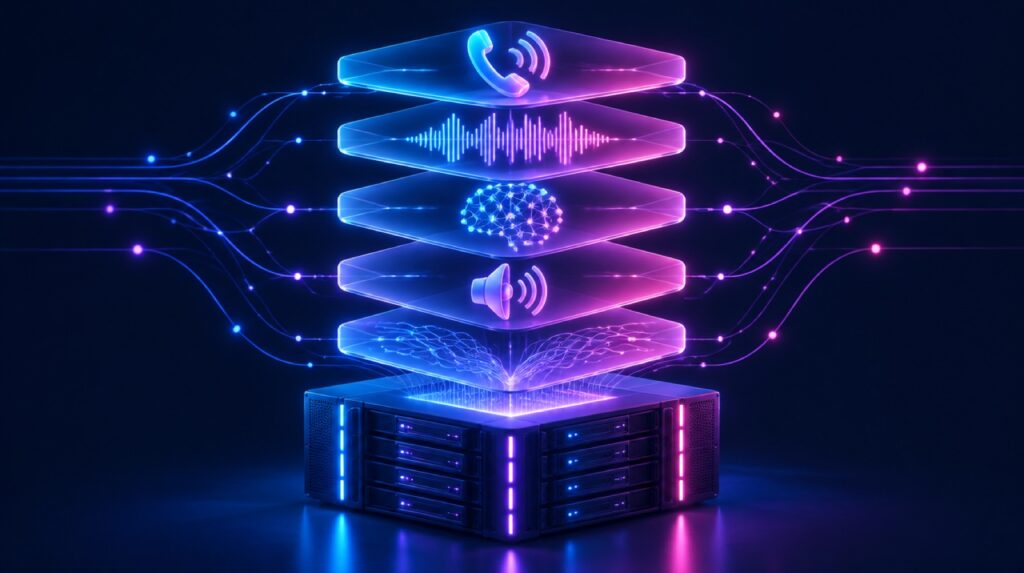
Search GitHub for “AI voice agent” and you will find hundreds of repositories, from weekend demos to serious frameworks. The appeal is obvious: no per-minute platform fee, full control over your data, and the freedom to change any part of the stack. But an AI voice agent open source project is rarely one download. It is a stack of five or six pieces, and you need to know which ones you will own and which ones you will rent.
This guide maps the open-source voice AI stack as of late 2026, explains what you can genuinely self-host today, and points out where teams in India usually get stuck.
The five layers of a voice agent
Every AI calling agent, open source or not, has the same layers. Thinking in layers makes it much easier to compare GitHub projects.
| Layer | Job | Open-source options (examples) |
|---|---|---|
| Telephony | Receive and place phone calls | Asterisk, FreePBX, FreeSWITCH |
| Orchestration | Stream audio, manage turns, interruptions, tools | Pipecat, LiveKit Agents |
| Speech-to-text (STT) | Turn caller speech into text | Whisper-family models, VEXYL-STT |
| Language model (LLM) | Decide what to say and which tool to call | Open-weight models served with Ollama or similar |
| Text-to-speech (TTS) | Speak the reply | VEXYL-TTS and other open models |
You can mix open and paid layers. Plenty of production systems run an open-source PBX and orchestrator with a paid LLM API, or a paid speech API with a local LLM. “Open source” is a spectrum, not a yes/no.
What you can self-host today
Telephony: mature and proven
Asterisk and FreePBX have run Indian call centres and office phone systems for years. They connect to SIP trunks from Indian operators and to existing IP-PBXs. This layer is the least risky part of an open-source voice stack. If you already run Asterisk, our walkthrough on an open-source Asterisk AI voice agent shows how to attach AI to it.
Orchestration frameworks
Two frameworks come up most often on GitHub:
- Pipecat: a Python framework for real-time voice and multimodal agents, BSD-2 licensed and maintained by Daily with the community (see the Pipecat repository). It is lower-level and lets you swap providers freely.
- LiveKit Agents: Apache-2.0 licensed, built around LiveKit’s WebRTC rooms and SIP support. It is a higher-level abstraction and ships faster if you accept its model.
Both are excellent building blocks. Neither is a finished product: you still write the call flow, the tools, monitoring, retry logic and the admin screens your operations team needs. Check each repository for current licence and release status before you commit.
Speech-to-text for Indian languages
This is where Indian deployments differ from Western tutorials. Generic open models often struggle with Indian accents, code-mixed speech and 8 kHz phone audio. You want a model trained or tuned on Indian languages and telephone-quality audio, and you want it to run on hardware you can afford. India’s public language stack is moving in this direction too: MeitY announced an open-source voice AI stack called VoicERA on the Bhashini platform in February 2026, aimed at multilingual government helplines.
Language models
Open-weight LLMs served locally (for example through Ollama) are now good enough for many scripted tasks: FAQs, appointment booking, simple qualification. For complex, free-form sales conversations, teams often still use a hosted model. The honest test is your own transcripts, not leaderboards.
Text-to-speech
Open TTS has improved fast. The key checks for India are: does it cover your languages, does it sound natural on a phone line, and can it stream audio so the caller hears the first words quickly?
Where open-source voice AI projects get stuck
Most failed projects do not fail on models. They fail on the plumbing between them.
- Latency: each layer adds delay. Batch STT plus a slow LLM plus non-streaming TTS easily adds up to a pause callers notice.
- Barge-in and echo: callers interrupt. The agent must stop talking, and it must not “hear” its own voice coming back through the line.
- Audio formats: phone audio is narrowband and needs resampling between telephony and AI models.
- Call transfer: handing a call to a human needs SIP REFER or PBX-specific logic.
- Operations: logs, cost tracking, restarts, concurrency limits and security patches are your job forever.
If you have a strong in-house engineering team, a framework plus your own glue code is a fine path. If you need to go live in weeks, consider a ready gateway for the plumbing and keep the open-source parts where they matter most to you, usually speech and data.
Open source vs self-hosted vs managed
These terms get mixed up. They are different questions.
| Option | Source code | Where it runs | Typical trade-off |
|---|---|---|---|
| Open-source framework | Open | Your servers | Full control, most engineering work |
| Self-hosted product | May be closed | Your servers | Data stays with you, less glue code |
| Managed platform | Closed | Vendor cloud | Fastest start, data and pricing set by vendor |
For Indian businesses handling health, finance or citizen data, “where it runs” often matters more than “is the code open”. The DPDP Act cares about how you process personal data, not about licences. Our guide to a self-hosted AI voice agent covers that decision.
A sensible open-source path
- Keep your existing telephony (Asterisk, FreePBX or your IP-PBX and SIP trunk).
- Pick open-source STT and TTS for your main languages and benchmark them on real call recordings.
- Decide on the LLM separately: local for simple bots, hosted where quality demands it.
- Choose your orchestration: build on a framework, or use a gateway that already handles streaming, barge-in and transfer.
- Measure cost per minute and latency from day one.
Questions to ask before you pick a GitHub project
Stars and demo videos do not tell you whether a repository will survive real calls. Before you build on any open-source voice AI project, check these:
- Licence: is it permissive (MIT, BSD, Apache 2.0) or does it carry obligations that affect how you ship your product?
- Activity: are issues answered and releases made regularly, or was the last commit a year ago?
- Telephony support: does it work with SIP, Asterisk or your PBX, or only with browser WebRTC?
- Indian languages: has anyone tested it on Hindi, Tamil or Malayalam phone audio?
- Concurrency: how many calls can one server handle, and how does it scale?
- Observability: does it log transcripts, latency and costs, or will you build that?
A project that scores well on these is a foundation. One that does not is a learning exercise, which is also fine, as long as you know which one you are holding.
How VEXYL fits
VEXYL publishes two open-source speech projects on the vexyl-ai GitHub organisation:
- VEXYL-STT: self-hosted speech-to-text for 14 Indian languages, with WebSocket streaming and batch REST. It runs on CPU and has no per-minute fees. The VEXYL-STT launch post explains the setup.
- VEXYL-TTS: Apache 2.0 text-to-speech for 22 Indian languages with 44+ voices, streaming over WebSocket plus a batch API.
The VEXYL Voice Gateway itself is not open source, but its Developer edition is free and self-hosted for up to 4 concurrent calls. It handles the plumbing that open-source projects usually stall on: SIP trunk and Asterisk AudioSocket input, streaming STT and TTS, barge-in, and transfer to a human. You can plug in VEXYL-STT, Sarvam, Google, Deepgram and others for speech, and any LLM via LiteBot, n8n or your own HTTP endpoint. That gives you a mostly open, fully self-hosted stack without writing the glue yourself.
FAQ
Is there a fully open-source AI voice agent?
You can assemble one from open parts: Asterisk for telephony, Pipecat or LiveKit Agents for orchestration, open STT and TTS models, and a local LLM. Expect to write and maintain the integration code yourself.
Which open-source voice AI works best for Indian languages?
Test models on your own phone recordings. Look for models trained on Indian languages and narrowband telephone audio. VEXYL-STT and VEXYL-TTS were built for this use case; Bhashini’s public stack is another resource to watch.
Can open-source voice agents run without a GPU?
Some components can. VEXYL-STT is designed to run on CPU. Local LLMs and some TTS models run much faster on a GPU, so size your hardware based on concurrent calls.
Is an AI calling agent from GitHub ready for production?
Rarely as-is. Most repositories are frameworks or demos. Production needs monitoring, retries, security, call transfer and cost tracking. Budget engineering time for these.
Does open source make me DPDP compliant?
No. Compliance depends on how you collect, use, store and delete personal data. Self-hosting helps you control that, but it is not compliance by itself. This is not legal advice.
Want an open, self-hosted voice stack without building the plumbing? Download the free Developer edition of the gateway, pair it with VEXYL-STT and VEXYL-TTS, or talk to us about a larger rollout.