Open-Source AI Voice Agents: What You Can Self-Host Today
An open-source AI voice agent is a stack, not a single repo. This guide maps each layer you can self-host today and where projects usually get stuck.

What you can genuinely get free for an AI calling agent in India: self-hosted editions, open-source Indian-language speech, local models and provider credits, plus the costs that never go away.
Why Indian banks, hospitals and businesses are running AI voice agents on their own servers, what a self-hosted setup involves, and why VEXYL fits.
Vapi is popular with developers, but Indian teams often need rupee-friendly costs, Indian languages, local telephony and data on their own servers. Here are the alternatives and how to choose.
Asterisk can talk to an AI agent in three main ways. Here is how AudioSocket, ARI and SIP compare, which open-source projects exist, and what to check before you put one in production.
Self-hosting a voice agent is not all-or-nothing. You can keep call handling on your servers and still use cloud AI, or run everything, speech and LLM included, inside your own network. Here is how to choose.
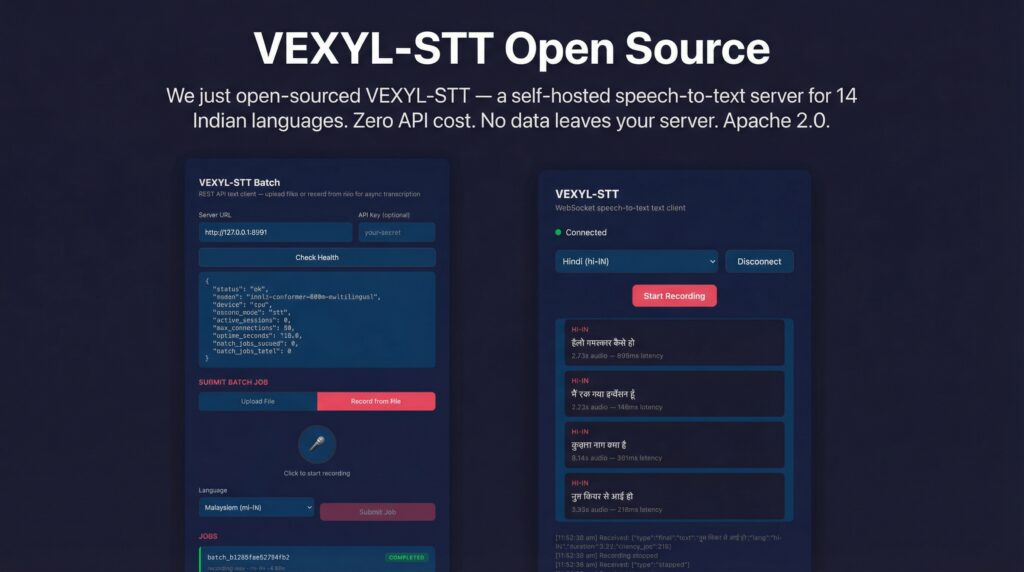
If you’ve ever tried to add self-hosted Indian language speech to text to a production system, you know the problem. Cloud STT APIs either don’t support Indian languages well, charge per-minute fees that kill your margins, or send audio to servers in the US — which is a non-starter for healthcare and government use cases. […]