Voice AI for Government Helplines and Citizen Services
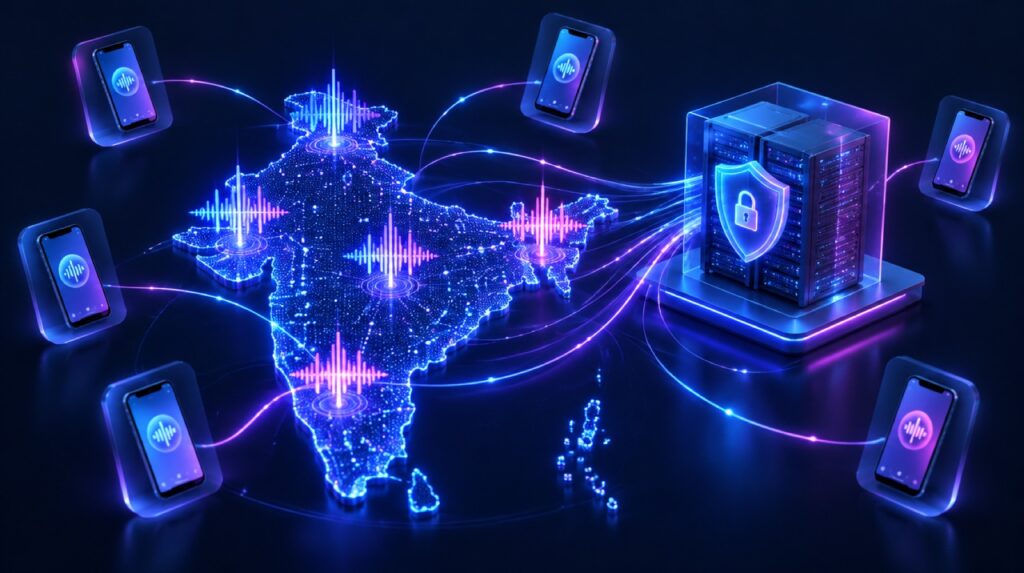
Government helplines in India carry some of the heaviest call loads anywhere: scheme enquiries, grievance status, certificate applications, utility complaints, health and agriculture advisories. Many callers are not comfortable with English menus or smartphone apps, and they call in their own language. Voice AI for government offers a way to answer those calls around the clock, in Indian languages, while keeping trained staff for the cases that need judgement.
This guide looks at where voice AI helps public services, what design choices matter for citizens, and why data residency and on-premise deployment are central for any government AI voice bot.
Why government is turning to voice AI
The policy direction is clear. India’s national language platform, Bhashini, provides speech-to-text, text-to-speech and translation services for Indian languages, and government bodies have been building on it. In February 2026, MeitY unveiled VoicERA, an open-source voice AI stack on Bhashini infrastructure aimed at multilingual helplines and scheme discovery. In August 2026, the Digital India Bhashini Division and NITI Aayog signed a statement of intent to advance voice-first, multilingual AI for citizen services. Several states have also announced multilingual service programmes.
The practical reasons are simple:
- Volume: helplines face huge spikes around scheme deadlines, results, exams and disasters.
- Language: a caller in rural Odisha or Kerala should not have to switch to Hindi or English to get an answer.
- Reach: a phone call works on any handset, without data or literacy barriers.
- Consistency: every caller gets the same, current answer on eligibility and documents.
Where a citizen helpline AI helps most
| Service | What voice AI can handle | What should stay with staff |
|---|---|---|
| Scheme information | Eligibility questions, documents list, how to apply | Edge cases, disputed eligibility |
| Grievance status | Look up a complaint number, read current status | Escalations, sensitive complaints |
| Certificates and applications | Status checks, office timings, fee information | Corrections and exceptions |
| Municipal and utility services | Register water, power or sanitation complaints | Field coordination |
| Health and outreach | Reminder and awareness calls, camp schedules | Clinical advice |
| Feedback and surveys | Short outbound surveys on service delivery | Analysis and follow-up |
A common first step is replacing a “press 1 for…” IVR with a conversational one, where the caller simply says what they need. Our AI IVR system article explains how that differs from a menu-based IVR.
Design principles for public service voice AI
Language first
Offer the state’s main language as the default, with easy switching. Test speech recognition on rural accents, dialects and code-mixed speech, not just standard pronunciation. For voices, check our overview of text-to-speech for Indian languages.
Always offer a human
Citizens must be able to reach a person, especially for grievances, distress or anything involving entitlements. Make “talk to an officer” work at any point in the call, and transfer with the context already logged.
Say what the AI cannot do
A government bot must not guess. If it does not know, it should say so and route the call. Answers on eligibility and benefits must come from approved documents in a knowledge base, not from the model’s general knowledge.
Be transparent
Tell callers at the start that they are speaking to an automated assistant and whether the call is recorded.
Design for spikes
Plan concurrency for the worst day of the year, not the average day. Scheme deadlines and emergencies create sudden peaks.
Data residency, security and the DPDP Act
Citizen calls contain names, Aadhaar-linked details, addresses, health information and complaints. Where that data is processed and stored is a primary question for any public deployment.
India’s Digital Personal Data Protection Act 2023 and the DPDP Rules, notified in November 2025, set obligations for how personal data is processed, with most provisions phasing in by around May 2027. Government departments and their vendors should work through how the Act and any applicable exemptions apply to each service, along with departmental IT and security policies. Our DPDP Act guide for AI voice agents covers the basics. This is general information, not legal advice.
Practical requirements that usually come up in public sector reviews:
- On-premise or government cloud deployment: call audio, transcripts and logs stay within approved infrastructure.
- Choice of AI providers: the ability to use self-hosted speech models and local LLMs, so no call data leaves the network if policy requires it.
- Integration with existing telephony: working with the department’s current PBX and SIP trunks rather than replacing them.
- Audit trail: stored transcripts and tool actions for review.
- Retention rules: clear deletion schedules for recordings and transcripts.
This is where self-hosted voice AI has a real edge over SaaS-only platforms. We compare the two models in self-hosted vs cloud voice AI, and our self-hosted AI voice agent guide covers the infrastructure side.
A phased rollout for a government helpline
- Pick one high-volume, low-risk service, such as scheme information or complaint status.
- Prepare approved content: official FAQs, circulars and office details, loaded into a knowledge base.
- Connect overflow and after-hours calls first, keeping staff on daytime calls.
- Review transcripts weekly with the department, correcting answers and adding content.
- Extend to more languages and services once quality is proven.
- Add outbound awareness and feedback calls when inbound is stable.
Measuring success in public service
Government helplines are judged on access and resolution, not on sales. Track measures that reflect what citizens experience:
- Answer rate: share of calls answered, especially at peak times and after hours.
- Resolution without transfer: share of calls fully handled by the AI, by service type.
- Transfer reasons: why callers needed a person, which shows where content or design is missing.
- Language coverage: call volume and success rate per language, to spot languages where speech recognition struggles.
- Repeat calls: citizens calling back about the same issue within a few days, a sign the first answer did not help.
- Cost per resolved call: useful for budgeting and for expanding to more departments.
Share these numbers with the department’s team every month. They are what turns a pilot into a funded service.
How VEXYL fits
VEXYL is built to run on infrastructure you control, which suits public sector requirements:
- On-prem host mode: the VEXYL Voice Gateway and LiteBot run as single binaries or Docker containers (Kubernetes is also supported) inside your data centre or approved cloud.
- Self-hosted speech: VEXYL-STT covers 14 Indian languages and runs on CPU; VEXYL-TTS covers 22 Indian languages with 44+ voices. You can also plug in Sarvam, Google, Azure and other providers where policy allows.
- Local LLMs: LiteBot supports Ollama for models running on your own servers, alongside hosted providers.
- Existing telephony: connect through SIP trunks, Asterisk, FreePBX and IP-PBX systems such as Panasonic, Avaya IP Office, Grandstream and Bitvoice; see the IP-PBX vendor docs.
- Knowledge base and audit: answers come from documents you upload, and every conversation, tool action and cost is stored for review.
We do not claim any government certification; departments should run their own security and compliance review.
FAQ
How is voice AI used in government services in India?
For helplines that answer scheme and service questions, check grievance or application status, register complaints and run awareness or feedback calls, increasingly in Indian languages through platforms like Bhashini.
Can a government AI voice bot run fully on-premise?
Yes, if every component can be self-hosted: telephony, speech-to-text, the language model and text-to-speech. Self-hosted speech models and local LLMs make that possible.
Which Indian languages can a citizen helpline AI support?
That depends on the speech models used. VEXYL-STT supports 14 Indian languages and VEXYL-TTS 22. Always test each language with real callers from the region.
Will voice AI replace helpline staff?
It should not. It handles repetitive questions and peaks, so staff can focus on complaints, exceptions and callers who need a person.
How do we keep answers accurate?
Restrict the bot to approved documents through a knowledge base, tell it to transfer when unsure, and review transcripts regularly with the department.
Planning a multilingual, on-premise citizen helpline? Contact our team to discuss an Enterprise deployment, or evaluate the stack first with the free Developer edition.