How VEXYL AI Simplifies n8n Voice AI Workflows
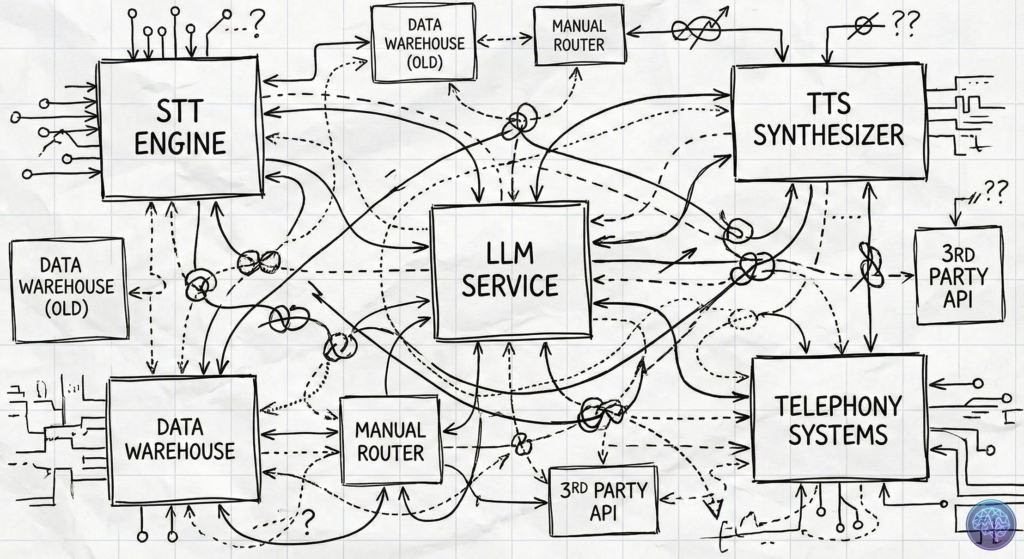
Building real-time voice AI workflows with n8n has traditionally required months of development and deep telephony expertise.VEXYL AI Voice Gateway changes n8n Voice AI Workflows equation entirely. As someone who’s worked with enterprise voice systems across Indian healthcare sector, I can tell you that VEXYL simplifies n8n voice AI integration from a 3-6 month project down to just 1-2 weeks. It’s a game-changer for organisations seeking self-hosted voice automation without the complexity.
What Makes Voice AI Integration with n8n So Challenging?
n8n is brilliant at connecting different services and automating complex workflows. But voice AI introduces unique technical challenges that most workflow tools simply weren’t designed to handle.
First, there’s the telephony integration problem. Traditional phone systems use protocols like SIP and Asterisk AudioSocket that don’t natively connect to modern workflow automation platforms. You can’t just drag-and-drop a “phone call” node into n8n and expect it to work with your existing PBX system. The gap between legacy telephony infrastructure and modern automation tools is substantial.
Second, real-time processing demands are brutal. Voice conversations require sub-200ms response times for interactions to feel natural. That means your entire pipeline—speech-to-text conversion, AI processing, and text-to-speech generation—needs to complete in under two seconds. Achieving this whilst managing audio format conversions, session state, and error handling is genuinely difficult.
Third, there’s the data sovereignty issue. Many organisations, particularly in healthcare, government, and regulated industries, need on-premise solutions. Cloud-based platforms like Vapi and Retell charge ₹8-15 per minute and require your voice data to pass through their infrastructure. For a contact centre handling 30,000 minutes monthly, that’s ₹2.4 to ₹4.5 lakhs in recurring costs—every single month.
How Does VEXYL AI Bridge n8n and Telephony Systems?
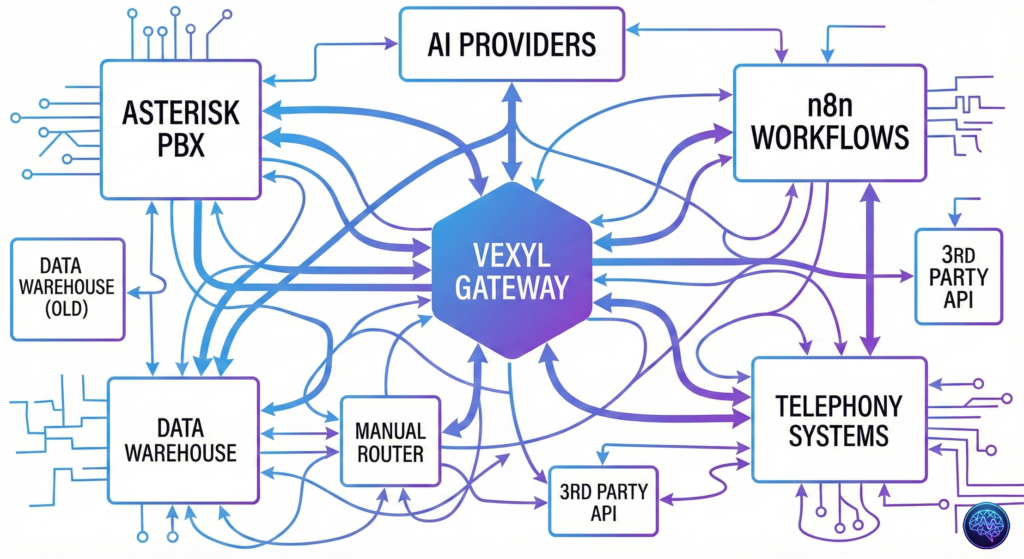
VEXYL acts as intelligent middleware sitting between your existing telephony infrastructure and n8n workflows. Think of it as a translation layer that speaks “telephony” on one side and “modern API” on the other.
Here’s what VEXYL handles automatically: it connects directly to your Asterisk PBX or SIP server through the AudioSocket protocol, manages the complete STT→LLM→TTS pipeline, maintains session state across conversations, handles audio format conversions (8kHz phone audio, 16kHz STT, 22.05kHz TTS), implements retry mechanisms and circuit breakers for reliability, and caches frequently used TTS responses for lightning-fast replies.
Your n8n workflow only needs to handle the business logic. Send appointment data? That’s a simple HTTP request node. Query your database? Standard database node. Update records based on conversation outcome? Another HTTP request. The complexity stays hidden inside VEXYL where it belongs.
Native Multi-Provider Support
VEXYL integrates with 17+ AI providers out of the box. For speech-to-text, you’ve got Sarvam AI (brilliant for Indian languages), Groq, Whisper, and Google Cloud Speech. For LLMs, choose from OpenAI, Gemini, Litebot, or any other API-compatible provider. Text-to-speech options include Google Cloud, Azure, ElevenLabs, and again Sarvam AI for regional language support.
This flexibility is massive. In my experience, organisations typically want Sarvam for Malayalam/Hindi conversations, Groq for cost-effective English processing, and ElevenLabs when voice quality is paramount. VEXYL AI lets you mix and match without rewriting your n8n workflows.
Can You Show a Real-World n8n Voice AI Implementation?
Let’s walk through a healthcare appointment reminder system—the exact use case deployed in Kerala hospitals processing over 1,000 patient calls monthly.
Traditional Approach (Without VEXYL)
Building this from scratch means you’d need to set up and configure a telephony server, integrate separate STT services, build audio processing pipelines with FFmpeg, connect to LLM APIs manually, integrate TTS services, implement call state management, handle session tracking across disconnections, and build error handling and retry mechanisms.
Estimated development time? Three to six months with a skilled engineering team. Total cost? ₹15-30 lakhs for custom development. That’s assuming nothing goes wrong.
With VEXYL + n8n
The workflow becomes remarkably simple. VEXYL handles the voice pipeline, your n8n workflow handles the business logic. Development time drops to 1-2 weeks. I’ve seen teams deploy production systems in under 10 days.
Here’s the n8n workflow structure:
- Webhook Trigger receives call start event from VEXYL
- Database Query fetches patient appointment details from your hospital management system
- Function Node prepares conversation context with patient name, appointment date, and doctor details
- HTTP Request to VEXYL sends context and natural language instructions
- Webhook receives conversation outcome (confirmed, rescheduled, or cancelled)
- Switch Node routes based on patient response
- Database Update modifies appointment status accordingly
- Notification Node alerts healthcare staff if appointment cancelled or needs attention
That’s it. Eight nodes in n8n, all using standard HTTP requests and database operations. No custom code. No telephony expertise required.
What Performance Can You Achieve with VEXYL and n8n?
Performance metrics matter enormously in voice AI. Customers notice delays beyond 2 seconds, and anything over 3 seconds feels broken. Here’s what organisations typically achieve with VEXYL:
Response times: Sub-200ms for cached TTS responses (like common greetings), 2.2-3.3 seconds for full STT→LLM→TTS pipeline, and consistent 90% TTS cache hit rates after first week of operation.
Scalability: 20-50 concurrent calls on standard deployment using 4-core servers, thousands of concurrent calls possible with PM2 clustering, and support for 30,000 minutes monthly on mid-tier infrastructure.
Reliability: Circuit breaker patterns prevent cascade failures, automatic retry mechanisms for transient errors, 99.9% uptime in production deployments, and detailed logging for troubleshooting.
Accuracy: 95%+ speech recognition for Malayalam, Hindi, Tamil, Telugu, and Kannabi conversations, 98%+ accuracy for English, and intelligent context handling reduces misunderstandings.
How Much Does VEXYL Save Compared to Cloud Platforms?
Let’s talk numbers, because cost predictability matters for budgeting. The comparison is stark.
Cloud-Based Per-Minute Platforms
Vapi charges approximately $0.05 per minute plus platform fees, plus separate charges for LLM, STT, and TTS usage. Retell AI charges $0.07 per minute with more transparent pricing. For 30,000 minutes monthly, you’re looking at ₹2.4 to ₹4.5 lakhs recurring costs. That’s ₹28.8 to ₹54 lakhs annually.
The real killer? These costs never stop. They scale linearly forever. Double your call volume, double your costs. Every single month.
VEXYL + n8n Self-Hosted
VEXYL uses a Bring Your Own Keys (BYOK) model. You pay your chosen AI providers directly at their API rates—typically 80-90% cheaper than bundled per-minute pricing. One-time license fees range from ₹50,000 for 10 concurrent calls to ₹2,00,000 for enterprise deployments with 50+ concurrent calls.
Infrastructure costs? A decent 4-core, 16GB RAM server costs ₹15,000-25,000 monthly. Total first-year cost for 30,000 minutes monthly: approximately ₹3-5 lakhs. That’s 87-91% savings compared to cloud platforms.
Second year onwards? Just infrastructure and API costs. The license is perpetual.
| Platform | Monthly Cost (30K mins) | Annual Cost | Savings |
|---|---|---|---|
| Vapi | ₹2.4-4.5 lakhs | ₹28.8-54 lakhs | Baseline |
| Retell AI | ₹2.1 lakhs | ₹25.2 lakhs | Baseline |
| VEXYL + n8n | ₹25,000-40,000 | ₹3-5 lakhs | 87-91% |
What About Indian Language Support?
This is where VEXYL truly shines for the Indian market. Supporting 10+ regional languages isn’t just a nice-to-have—it’s essential for serving diverse populations.
VEXYL natively integrates with Sarvam AI, which provides excellent Malayalam, Hindi, Tamil, Telugu, Kannada, Gujarati, Bengali, Marathi, Punjabi, and Odia support. The Kerala healthcare deployments conduct entire conversations in natural Malayalam, achieving 95% patient satisfaction rates.
From your n8n workflow perspective, language selection is just another parameter. Want to switch from Malayalam to Hindi based on patient preference? Update one field in your HTTP request to VEXYL. The complexity of managing multiple STT and TTS providers for different languages stays hidden.
What Are the Key Features That Simplify Integration?
Several VEXYL features specifically make n8n integration dead simple.
Webhook-First Architecture
Everything communicates through standard webhooks and REST APIs. Your n8n workflows trigger on incoming calls, send context via HTTP requests, and receive conversation outcomes through return webhooks. No custom nodes required. No SDKs to install. Just HTTP requests—the exact same pattern you use for every other n8n integration.
Automatic Session Management
VEXYL maintains call sessions and conversation state automatically. Your n8n workflow can query conversation status mid-call, inject additional context on the fly, or update instructions based on database lookups—all without managing complex session tracking yourself.
Smart TTS Caching
Common phrases like greetings, appointment confirmations, and standard questions get cached automatically. Response times drop from 1-2 seconds to just 2ms for cached content. Your n8n workflows benefit from this optimisation without any additional configuration. After the first week of operation, 90% of TTS requests hit the cache.
Dual Operational Modes
VEXYL supports two modes. Standard Mode gives you full control—your n8n workflow orchestrates the entire conversation with custom business logic and data integration. Gateway Mode streams audio directly to providers like OpenAI Realtime API when you need ultra-low latency but don’t require custom workflow integration. Choose the mode that fits your use case.
How Quickly Can You Deploy Your First Voice Bot?
Here’s a realistic timeline based on actual customer deployments:
Day 1: Deploy VEXYL using Docker or binary executable on your infrastructure. Configure connection to Asterisk PBX or SIP server. Add API keys for your chosen STT, LLM, and TTS providers. This typically takes 2-4 hours.
Day 2-3: Build your first n8n workflow with webhook trigger, database query nodes, and HTTP request nodes to communicate with VEXYL. Test with sample data. Refine conversation prompts based on initial results. This stage usually takes one to two days depending on complexity.
Day 4-5: Make test calls with real data. Monitor response times and conversation quality. Iterate on prompts and error handling. Set up logging and monitoring.
Day 6-10: Pilot deployment with limited call volume. Gather feedback from actual users. Make final adjustments to conversation flows.
Day 11-14: Scale to production volumes. Implement PM2 clustering if needed for higher concurrent call capacity. Monitor performance metrics and optimise as needed.
Total time to production: 1-2 weeks. Compare that to 3-6 months for custom development.
What About Security and Compliance?
Data sovereignty is non-negotiable for many organisations, particularly in healthcare, government, and regulated industries.
VEXYL’s self-hosted deployment means sensitive voice data never leaves your infrastructure. This matters enormously for HIPAA compliance in healthcare, GDPR requirements in Europe, and various data localisation mandates in India. Your patient conversations, customer interactions, and business communications stay on your servers under your control.
Complete logging provides audit trails for compliance and quality assurance. Integration with existing authentication systems happens through your n8n workflows—use whatever access control mechanisms you already have in place. All API communications between VEXYL and n8n support TLS/SSL encryption.
Are There Limitations or Trade-offs to Consider?
I’d be remiss if I didn’t mention the trade-offs. Self-hosted solutions aren’t right for every organisation.
You need infrastructure. Whether that’s on-premise servers, private cloud instances, or dedicated VPS hosting, you’re responsible for maintaining the infrastructure. Cloud platforms like Vapi handle this for you—that’s what you’re paying for with their per-minute pricing.
You need some technical capability. Whilst VEXYL dramatically simplifies voice AI integration, you still need someone who can deploy Docker containers, configure n8n workflows, and troubleshoot when issues arise. If your organisation has zero technical staff, managed cloud platforms might suit you better.
Scaling requires planning. Whilst VEXYL handles 20-50 concurrent calls easily on standard hardware, scaling to hundreds of concurrent calls means implementing clustering, load balancing, and proper monitoring. Cloud platforms handle this scaling automatically (whilst charging you proportionally).
That said, for organisations with existing IT infrastructure and technical teams—which includes most enterprises, healthcare systems, and government agencies—these trade-offs are minimal compared to the massive cost savings and data control benefits.
Can n8n handle real-time voice conversations natively?
No, n8n doesn’t include built-in telephony or real-time voice processing capabilities. Whilst n8n excels at workflow automation and API integration, connecting to phone systems requires a voice AI gateway like VEXYL. VEXYL bridges this gap by handling telephony protocols (SIP, Asterisk AudioSocket), audio processing, and speech-to-text/text-to-speech pipelines, exposing simple REST APIs that n8n workflows can call using standard HTTP request nodes.
How much does VEXYL cost compared to Vapi or Retell AI?
VEXYL typically saves 87-91% compared to cloud platforms. For 30,000 minutes monthly, Vapi costs ₹2.4-4.5 lakhs per month (₹28.8-54 lakhs annually), whilst Retell AI costs approximately ₹2.1 lakhs monthly (₹25.2 lakhs annually). VEXYL uses one-time licensing (₹50,000-2,00,000 depending on concurrent call capacity) plus infrastructure costs (₹15,000-25,000 monthly), totaling ₹3-5 lakhs in the first year. The license is perpetual, so subsequent years cost even less.
Does VEXYL support Indian languages like Hindi and Malayalam?
Yes, VEXYL natively supports 10+ Indian languages including Malayalam, Hindi, Tamil, Telugu, Kannada, Gujarati, Bengali, Marathi, Punjabi, and Odia through integration with Sarvam AI and other providers. Kerala healthcare deployments currently process over 1,000 patient interactions monthly in Malayalam with 95% satisfaction rates. Language selection is configurable per call through your n8n workflow, allowing you to serve multilingual customer bases without separate integrations.
What technical skills are needed to deploy VEXYL with n8n?
You need basic DevOps skills to deploy Docker containers or binary executables, familiarity with n8n’s visual workflow editor (no coding required for workflow creation), understanding of REST APIs and webhooks for integration, and access to infrastructure (on-premise servers or cloud VPS). If your organisation already uses n8n and has IT staff managing servers, deployment typically takes 2-4 hours. No telephony expertise or audio processing knowledge is required—VEXYL handles those complexities.
Can VEXYL integrate with existing Asterisk PBX systems?
Yes, VEXYL connects directly to Asterisk PBX systems through the AudioSocket protocol. It also supports standard SIP servers and is expanding compatibility to FreeSWITCH and other telephony platforms. This means you don’t need to replace your existing phone infrastructure—VEXYL works as middleware between your current telephony system and modern n8n workflows. Configuration typically involves adding VEXYL as an AudioSocket destination in your Asterisk dialplan.
Ready to Transform Your Voice AI Workflows?
VEXYL AI Voice Gateway eliminates the complexity of connecting n8n workflows to telephony systems. What traditionally required 3-6 months of development and deep technical expertise now takes 1-2 weeks with standard n8n workflow patterns.
The combination of self-hosted deployment (ensuring data sovereignty), massive cost savings (87-91% compared to cloud platforms), native Indian language support (10+ regional languages), and simple webhook-based integration makes VEXYL the ideal voice AI gateway for organisations seeking to add conversational AI capabilities without the complexity or recurring per-minute costs of cloud alternatives.
Whether you’re implementing appointment reminders for healthcare systems, building customer support automation, or creating voice-enabled business processes, VEXYL transforms n8n from a workflow automation tool into a complete enterprise voice AI platform.