FCC SIP 603+ Compliance Mandate – How AI Voice Platforms Must Adapt by March 2026
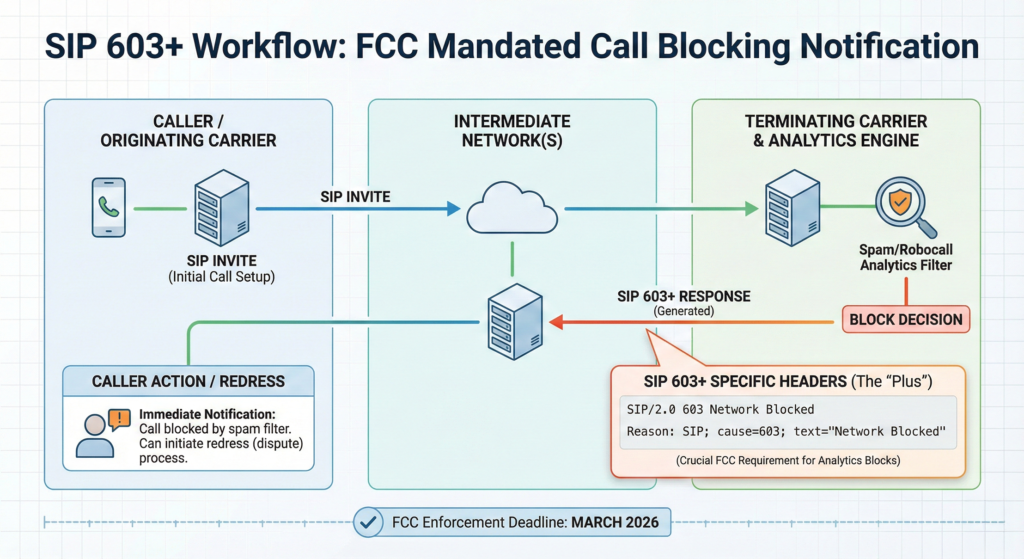
The telecommunications industry is facing a critical compliance deadline that will reshape how carriers handle blocked calls. By March 25, 2026, the FCC mandates that all voice service providers implement SIP 603+ response codes when blocking calls based on analytics engines. For businesses running AI voice platforms, outbound calling campaigns, or enterprise contact centres, this isn’t just a technical change—it’s a fundamental shift in transparency and accountability.
If you’re operating AI-powered voice systems like VEXYL, your platform sits right at the intersection of this regulation. The good news? With proper preparation, SIP 603+ compliance becomes an opportunity to improve call delivery rates, build caller trust, and demonstrate regulatory leadership. Let’s break down what’s changing and how forward-thinking voice platforms are adapting.
What is SIP 603+ and Why Does It Matter?
Session Initiation Protocol (SIP) codes are the backbone of modern telecommunications signalling. When a call can’t be completed, the network sends back a specific code explaining why. Until now, carriers have used generic codes like standard SIP 603 (“Decline”), which gave callers almost no useful information about why their call was blocked.
The TRACED Act (Telephone Robocall Abuse Criminal Enforcement and Deterrence) requires carriers to provide transparent notification when calls are blocked by analytics engines. After years of temporary measures, the FCC has standardised on SIP 603+ as defined in ATIS-1000099 specification.
Here’s what makes SIP 603+ different from standard SIP 603:
- Modified status line with distinct identifiers
- Mandatory text fields indicating the specific reason for blocking
- Network attribution showing which analytics provider made the blocking decision
- Dispute mechanism information enabling callers to quickly resolve incorrect blocks
The regulation affects all providers in the call path—not just terminating carriers. If you’re an originating provider, intermediate carrier, or gateway operator, you must properly handle and transmit SIP 603+ responses back to the call origination point.
Timeline and Technical Requirements
The Federal Register published the Eighth Report and Order on March 24, 2025, setting the implementation deadline at March 25, 2026—exactly 12 months from publication. This gives voice service providers one year to upgrade systems, test interoperability, and ensure proper code mapping across hybrid TDM and IP networks.
Key Technical Requirements by Network Type
IP Networks (VoIP, SIP Trunks):
- Terminating providers blocking calls via analytics must return SIP code 603+
- All intermediate providers must transmit the full 603+ header without modification
- Standard SIP 603 can still be used for non-analytics blocking (like user-initiated blocks)
- SIP 607 remains valid for subscriber-directed blocking without analytics
TDM Networks (Traditional Telephony):
- Use ISUP code 21 with cause location “user” for analytics-based blocking
- When converting between IP and TDM, SIP 603+ must properly map to ISUP 21
- Converting from ISUP 21 to IP should map to SIP 603 or 603+ where appropriate
Sunset Provisions:
- Providers must cease using SIP codes 603, 607, and 608 for analytics-based blocking by the March 2026 deadline
- These codes can still be used for their original intended purposes (user rejections, manual blocks)
- Software upgrades must ensure proper code mapping across all network transitions
How This Impacts AI Voice Calling Platforms
If you operate an AI voice gateway, contact centre platform, or automated calling system, SIP 603+ introduces both challenges and opportunities. Let’s examine the specific implications for different use cases.
The Perfect Storm: Legitimate AI Calls Getting Blocked
Here’s the uncomfortable truth: carrier analytics engines are increasingly flagging legitimate AI-powered business calls as spam. According to recent industry data, businesses relying on outbound AI calling for healthcare reminders, appointment confirmations, financial services, and customer support are seeing dramatic drops in call completion rates.
Why does this happen? Analytics engines look for patterns that scammers use—high call volumes, multiple numbers, predictable calling patterns, and yes, AI-generated voices. When you deploy an AI voice agent to make 1,000 appointment reminders in a day, you trigger the same red flags that illegal robocallers trip.
A recent study found that over 75% of consumers ignore unidentified calls, and when calls are tagged as “Spam Likely,” answer rates drop below 5%. For businesses using AI calling for legitimate purposes—patient appointment reminders, booking confirmations, payment notifications—this creates a catastrophic problem.
Industries particularly affected include:
- Healthcare – Patient appointment reminders, prescription notifications, test result follow-ups
- Financial Services – Payment reminders, fraud alerts, account verification
- Hospitality – Booking confirmations, check-in reminders, special offer notifications
- Real Estate – Property showing confirmations, mortgage application updates, viewing reminders
- Automotive – Service appointment reminders, recall notifications, delivery updates
What SIP 603+ Changes for AI Calling
With SIP 603+ compliance, when your AI voice platform’s calls are blocked by analytics, you’ll receive immediate, detailed notification including:
- Which analytics provider made the blocking decision
- The specific reason your calls were flagged (call pattern, number reputation, frequency, etc.)
- Contact information for disputing incorrect blocks
- Timestamp data showing when blocking started
This transparency is a game-changer. Instead of wondering why your call completion rates suddenly dropped from 60% to 15%, you’ll have concrete data showing exactly which carriers are blocking your calls and why.
The Dispute Process Becomes Critical
One of the TRACED Act’s core requirements is providing effective redress for erroneous blocking. SIP 603+ notifications include information about how legitimate callers can dispute incorrect spam classifications.
For AI voice platforms, this means establishing clear workflows:
- Monitoring systems that track 603+ responses and alert when blocking patterns emerge
- Documentation processes proving your calls are legitimate business communications
- Direct relationships with analytics providers (FirstOrion, Hiya, TNS, etc.) to expedite unblocking
- Number reputation management through services like Free Caller Registry and call attestation
VEXYL’s Compliance Strategy and Implementation
As a self-hosted AI voice gateway that sits between traditional telephony infrastructure and modern AI services, VEXYL is uniquely positioned to help customers navigate SIP 603+ compliance. Here’s our multi-layered approach to ensuring full compliance before the March 2026 deadline.
1. Native SIP 603+ Response Handling
VEXYL already processes SIP responses from carrier networks through our Asterisk PBX integration layer. We’re implementing enhanced SIP 603+ detection and parsing that:
- Captures all 603+ response headers including mandatory text fields
- Logs detailed blocking information with timestamps, analytics provider attribution, and reason codes
- Triggers real-time alerts when blocking patterns exceed configurable thresholds
- Surfaces blocking data in the VEXYL dashboard analytics interface
- Provides API access to 603+ response data for integration with CRM and business intelligence tools
Our implementation handles both IP-based SIP trunks and TDM gateways that convert ISUP 21 to SIP 603/603+, ensuring compatibility across hybrid telecommunications environments.
2. Enhanced Call Analytics and Monitoring
We’re expanding our call analytics capabilities to help customers identify blocking issues before they become critical:
- Call completion rate tracking by destination carrier, time of day, and number source
- SIP response code analytics showing trends in blocking frequency
- Number reputation scoring based on historical blocking patterns
- Automatic anomaly detection when completion rates drop below baseline
- Webhook notifications for immediate alerting when blocking begins
This visibility is crucial for outbound calling operations. When a healthcare system is making 1,000 appointment reminders daily, they need to know immediately if a major carrier starts blocking their calls.
3. Caller ID Authentication and STIR/SHAKEN Support
While SIP 603+ addresses notification of blocking, preventing blocks in the first place requires strong caller ID authentication. VEXYL is implementing:
- STIR/SHAKEN attestation support for cryptographically signed caller ID verification
- Branded calling integration to display company name and logo on receiving devices
- Rich Call Data (RCD) support for enhanced caller identity information
- Number registration guidance helping customers register with analytics providers
Proper caller ID authentication dramatically reduces the likelihood of legitimate calls being flagged as spam. Combined with SIP 603+ monitoring, this creates a comprehensive call deliverability strategy.
4. Best Practices Documentation and Customer Support
Technical compliance is only part of the equation. We’re developing comprehensive guidance for customers operating outbound AI calling campaigns:
- Call pattern optimisation to avoid triggering spam detection algorithms
- Number rotation strategies for high-volume calling operations
- Do-Not-Originate (DNO) list integration to prevent calls to invalid numbers
- Dispute process workflows with analytics providers
- Industry-specific compliance guides for healthcare, financial services, and other regulated sectors
5. Data Sovereignty and Privacy Compliance
One of VEXYL’s core advantages is self-hosted deployment giving customers complete control over voice data. This becomes particularly important with SIP 603+ compliance, as blocking notifications may contain sensitive information about call patterns and business operations.
Our implementation ensures:
- All SIP 603+ logs remain on customer infrastructure—no data leaves your network
- Encryption of blocking analytics data both at rest and in transit
- Configurable retention policies for compliance with data protection regulations
- Audit logging of who accessed blocking information and when
For organisations in highly regulated industries like healthcare and finance, this level of control is non-negotiable. You shouldn’t have to sacrifice data sovereignty to achieve telecommunications compliance.
Preparing Your AI Voice Operations for March 2026
Whether you use VEXYL or another voice platform, here’s a practical roadmap for SIP 603+ compliance:
Q1 2026 (January – March): Foundation Phase
- Audit your current infrastructure – Document all SIP trunk providers, PBX systems, and carrier relationships
- Review SIP response handling – Ensure your systems can capture and log extended SIP headers
- Test with carriers – Ask your SIP trunk providers about their 603+ implementation timeline
- Establish baseline metrics – Track current call completion rates and blocking incidents
- Register your numbers – Submit calling numbers to Free Caller Registry and analytics provider databases
Q2 2026 (April – June): Implementation Phase
- Deploy SIP 603+ monitoring – Implement logging and alerting for blocked calls
- Build dispute workflows – Create processes for contacting analytics providers when blocks occur
- Train your team – Ensure staff understand how to interpret blocking data and initiate disputes
- Test end-to-end – Verify proper 603+ handling across all network paths
- Document everything – Maintain records proving your calls are legitimate business communications
Q3 2026 (July – September): Optimisation Phase
- Analyse blocking patterns – Use 603+ data to identify which practices trigger spam detection
- Adjust calling strategies – Modify call volumes, timing, and number rotation based on learnings
- Enhance caller authentication – Implement STIR/SHAKEN and branded calling where possible
- Monitor effectiveness – Track improvements in call completion rates
- Maintain relationships – Stay engaged with carrier partners and analytics providers
Beyond Compliance: Strategic Advantages of SIP 603+
While compliance is mandatory, forward-thinking organisations are viewing SIP 603+ as a strategic opportunity rather than just a regulatory burden.
Improved Call Delivery Rates
When you understand exactly why calls are being blocked, you can address root causes. Is it your call volume pattern? The time of day? Number reputation? SIP 603+ gives you the data to optimise systematically rather than guessing.
Early adopters are reporting 15-30% improvements in call completion rates after using 603+ data to refine their calling strategies.
Enhanced Customer Trust
When consumers see “Spam Likely” on caller ID, they associate your brand with scammers. Being able to quickly dispute incorrect blocks and maintain clean number reputation protects brand equity.
For healthcare providers, this is particularly critical. A patient who misses an appointment reminder because your call was blocked represents both lost revenue and potentially compromised health outcomes.
Competitive Differentiation
Voice platform vendors that implement SIP 603+ support before the March 2026 deadline give their customers a significant advantage. Being able to demonstrate proactive compliance and provide detailed call analytics builds trust with enterprise buyers.
In competitive RFPs for AI voice solutions, compliance capabilities are increasingly becoming decision factors alongside features like latency, language support, and cost.
Common Misconceptions About SIP 603+
As with any new regulation, several myths have emerged. Let’s address the most common ones:
Myth 1: “This only affects terminating carriers, not originating platforms.”
Reality: All providers in the call path must properly handle and transmit SIP 603+ responses. If you originate calls, you’ll receive these notifications and need systems to process them.
Myth 2: “SIP 603+ will solve spam call problems.”
Reality: SIP 603+ addresses transparency and dispute mechanisms, not spam prevention itself. Analytics-based blocking will continue, but now with better notification.
Myth 3: “Small operators don’t need to comply.”
Reality: The regulation applies to all voice service providers, regardless of size. If you originate or carry voice traffic, you’re subject to these requirements.
Myth 4: “Implementing 603+ support is extremely expensive.”
Reality: For platforms with modern SIP infrastructure, implementation is straightforward. The real cost is in building monitoring and analytics around the data, which provides significant operational value.
Myth 5: “AI calling will become impossible after this regulation.”
Reality: Legitimate AI calling for business purposes remains legal and viable. SIP 603+ simply requires transparency when calls are blocked, helping legitimate businesses distinguish themselves from scammers.
Industry-Specific Considerations
Different industries face unique challenges with SIP 603+ compliance and AI calling. Here’s how this affects key sectors:
Healthcare and Medical Practices
Healthcare organisations using AI voice for appointment reminders, prescription notifications, and test results face special scrutiny. Call volumes are predictable (appointment reminders go out days in advance), making them easy for analytics engines to flag.
Key compliance considerations:
- HIPAA implications of logging SIP 603+ blocking data (ensure PHI isn’t exposed)
- Patient safety concerns when appointment reminders don’t connect
- Multi-language support requirements (VEXYL supports 10+ Indian languages including Malayalam)
- After-hours calling restrictions that may conflict with optimal delivery times
Financial Services and Fintech
Banks, credit unions, and fintech companies use AI calling for fraud alerts, payment reminders, and account verification. These calls are time-sensitive and critical for security.
Key compliance considerations:
- Regulatory requirements to demonstrate reasonable efforts to contact customers
- Fraud prevention protocols that require immediate call completion
- Multi-channel fallback strategies when voice calls are blocked
- Documentation for regulatory audits showing attempts to contact customers
E-commerce and Retail
Online retailers use AI calling for order confirmations, delivery notifications, and customer support. High call volumes during sales events make them particularly vulnerable to spam detection.
Key compliance considerations:
- Seasonal volume spikes triggering analytics alerts
- International calling for global customer base
- Customer consent and Do-Not-Call compliance
- Integration with CRM systems to track delivery attempts
The Future: What Comes After SIP 603+
SIP 603+ represents a significant step forward in call transparency, but it’s not the end of telecommunications evolution. Here’s what industry experts anticipate:
AI-Powered Call Authentication
As AI-generated voices become more sophisticated, carriers are developing voice biometric authentication that can detect synthetic speech patterns. Systems analysing over 1,000 vocal characteristics already achieve 92% precision in identifying AI-generated voices.
Future regulations may require AI voice platforms to declare themselves upfront, similar to the “This call may be monitored for quality assurance” disclaimers. Transparent AI identification could actually improve answer rates by building consumer trust.
Branded Calling and Rich Call Data
The FCC is strongly encouraging (though not yet mandating) branded calling solutions that display company name, logo, and call reason directly on receiving devices. This represents the future of legitimate business calling—proactive identification rather than reactive spam detection.
VEXYL is preparing integration points for branded calling services, ensuring customers can take advantage of these enhanced caller ID capabilities as they become standardised.
International Harmonisation
While SIP 603+ is currently a U.S. regulation, similar requirements are emerging globally. The GSMA’s Call Check initiative and other international standards bodies are developing comparable frameworks. Voice platforms with international operations need to prepare for multiple regulatory regimes.
What is SIP 603+ and when does it become mandatory?
SIP 603+ is a standardised Session Initiation Protocol response code that carriers must use when blocking calls based on analytics engines. It becomes mandatory on March 25, 2026, as mandated by the FCC’s Eighth Report and Order on robocalls. All voice service providers—terminating, originating, and intermediate—must implement proper 603+ handling by this deadline.
How does SIP 603+ affect legitimate AI calling platforms?
AI calling platforms will receive detailed notifications when their calls are blocked, including which analytics provider made the decision and why. This transparency helps legitimate businesses identify and resolve blocking issues quickly, dispute incorrect spam classifications, and optimise calling strategies to improve delivery rates. It’s both a compliance requirement and an operational advantage.
Do small voice service providers need to comply with SIP 603+?
Yes, the regulation applies to all voice service providers regardless of size. Any provider that originates, terminates, or carries voice traffic must properly handle SIP 603+ responses. There are no exemptions based on company size or call volume. However, implementation for platforms with modern SIP infrastructure is typically straightforward.
How is VEXYL preparing for SIP 603+ compliance?
VEXYL is implementing native SIP 603+ response handling, enhanced call analytics and monitoring, STIR/SHAKEN caller ID authentication support, and comprehensive customer documentation. All implementation maintains our core principle of data sovereignty—603+ logs remain on customer infrastructure with full encryption and audit capabilities. We’re targeting early compliance well before the March 2026 deadline.
What happens if AI calls continue getting blocked after SIP 603+?
SIP 603+ provides the transparency and dispute mechanisms to address blocking. When you receive a 603+ response, you’ll know exactly why calls were blocked and have clear pathways to dispute incorrect classifications. Combined with proper caller ID authentication, number registration, and calling pattern optimisation, legitimate businesses can significantly improve call delivery rates and maintain clean number reputation.
Take Action Now: Don’t Wait Until March 2026
The March 2026 deadline may seem distant, but preparing for SIP 603+ compliance requires strategic planning, infrastructure updates, and operational changes that take time to implement properly.
For organisations running AI voice operations, this is more than a compliance checkbox—it’s an opportunity to build more resilient, transparent, and effective calling systems that earn consumer trust and deliver measurable business results.
VEXYL’s self-hosted architecture, combined with our commitment to data sovereignty and regulatory compliance, positions us as a strategic partner for organisations navigating this transition. We’re not waiting until the deadline—we’re implementing SIP 603+ support now, giving our customers maximum time to test, optimise, and build competitive advantage.
If you’re operating AI voice systems for healthcare, financial services, contact centres, or any other industry where call delivery is mission-critical, now is the time to audit your infrastructure and ensure you’re prepared.
Want to learn more about VEXYL’s AI Voice Gateway and how we’re addressing telecommunications compliance? Explore our comprehensive documentation or request a personalised demo to see our platform in action.
One comment on “FCC SIP 603+ Compliance Mandate – How AI Voice Platforms Must Adapt by March 2026”
Great article on SIP 603+ compliance! This is such a crucial topic for AI voice platforms. I’m curious – how do you think these new transparency requirements might intersect with emerging SEO strategies for voice-based services? For instance, I recently came across this interesting approach about leveraging Google Business Profiles and Apple Maps for AI-driven visibility.