Call Centre AI Implementation: Best Practices Guide 2026

The landscape of customer service is transforming rapidly, and call centre AI implementation has become essential for businesses aiming to stay competitive. Whether you’re running a healthcare contact centre in Mumbai or a fintech support operation in Bangalore, implementing AI effectively can reduce operational costs by up to 30% while improving customer satisfaction scores by 15-20%. However, the difference between successful AI deployment and costly failure often comes down to following proven best practices. In this comprehensive guide, I’ll walk you through everything you need to know about implementing AI in your call centre, based on real-world insights and industry benchmarks from 2024-2025.
What is Call Centre AI and Why Does It Matter?
Call centre AI refers to the integration of artificial intelligence technologies—including machine learning, natural language processing, and predictive analytics—into customer service operations. It’s not about replacing human agents; it’s about augmenting their capabilities to deliver faster, more personalised service at scale.
The impact is significant. According to recent industry studies, AI can decrease Average Handle Time (AHT) by up to 40%, increase First Contact Resolution (FCR) rates by 35%, and boost agent productivity by up to 35%. For Indian businesses specifically, where labour costs are rising and customer expectations are evolving, AI offers a path to sustainable growth without proportional increases in headcount.
What makes this particularly relevant now is that 87% of customer experience leaders say generative AI is key for their teams, and 91% believe AI will help optimise CX strategies. The technology has matured beyond experimental phase—it’s delivering measurable ROI across industries from telecommunications to healthcare.
Understanding Call Centre AI: The Foundation
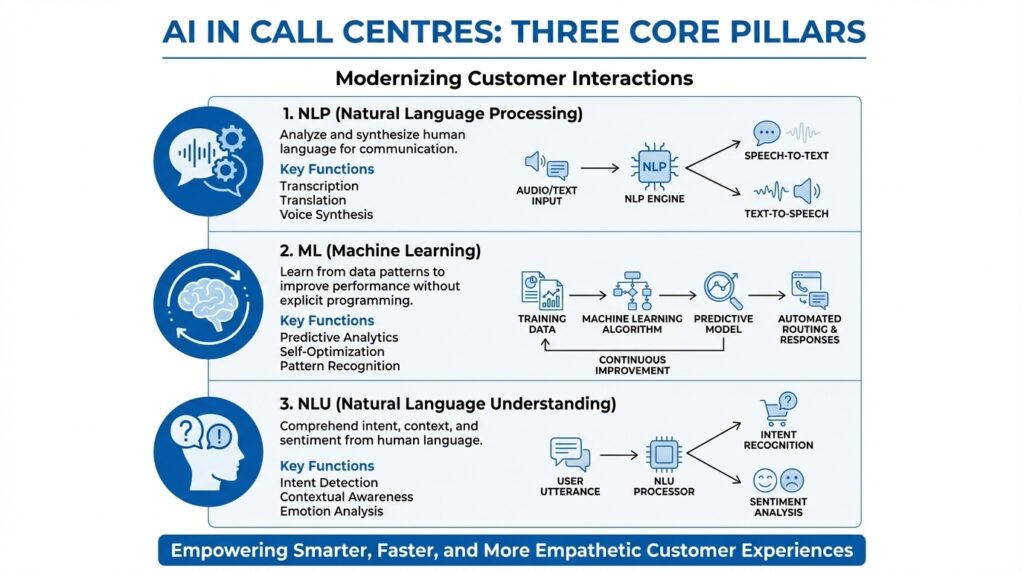
Before diving into implementation, it’s crucial to understand the core technologies that power modern AI call centres. These three pillars work together to create intelligent, responsive systems:
Natural Language Processing (NLP)
NLP allows AI systems to understand and respond to customer queries in natural, conversational language. It’s what enables chatbots to comprehend context and provide relevant answers. In the Indian context, advanced NLP systems can now handle multiple languages—crucial for serving customers across Hindi, Tamil, Telugu, and other regional languages alongside English.
Machine Learning (ML)
ML algorithms analyse patterns in historical data to predict customer behaviour, identify trends, and automate routine processes. For instance, ML can predict call volume spikes during festival seasons in India, allowing you to optimise staffing proactively. It continuously improves by learning from each interaction, becoming more accurate over time.
Natural Language Understanding (NLU)
NLU goes beyond basic language processing to detect emotional cues, sentiment, and context. This is particularly valuable for sentiment analysis—identifying when a customer is frustrated before the situation escalates. I’ve seen this make a dramatic difference in customer retention for healthcare and financial services clients.
How Do You Set Clear Goals for AI Implementation?
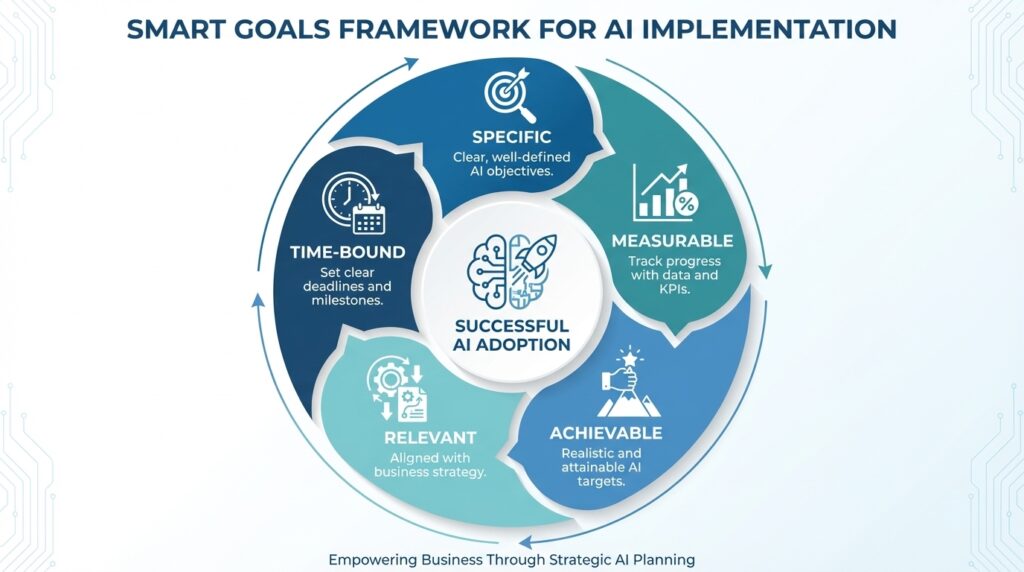
The single most important step in successful AI implementation is defining clear, measurable objectives aligned with your business needs. Too many organisations jump into AI adoption without a focused strategy, leading to scattered pilots with unclear ROI.
Start by identifying your primary objective. It should be one of these three categories:
- Revenue Growth: Improve conversion rates on high-intent calls, increase upsell opportunities, and capture more value from customer conversations.
- Cost Control: Reduce manual work, deflect routine requests through automation, and scale support without proportional headcount increases.
- Risk and Compliance: Standardise quality across interactions, ensure regulatory compliance, and maintain consistent service delivery.
Use the SMART framework to make your goals actionable. For example, instead of “improve customer satisfaction,” aim for “increase CSAT scores from 72% to 85% within six months by implementing AI-powered call summarisation and real-time agent assistance.”
In my experience working with Indian enterprises, I recommend starting with cost control objectives. They’re easier to measure and typically deliver ROI within 3-6 months, which helps build organisational confidence for more ambitious AI initiatives.
What is the Best Approach for Phased AI Implementation?
Attempting to transform your entire call centre overnight is a recipe for disaster. Successful AI implementation follows a phased approach that minimises risk while allowing time for organisational adaptation.
Phase 1: Assessment and Planning (4-6 weeks)
Begin with a thorough audit of current operations. Identify repetitive tasks, high-volume queries, and processes prone to human error. These are your prime candidates for AI automation. For instance, password resets, order status enquiries, and appointment scheduling typically offer quick wins.
During this phase, analyse your existing technology infrastructure. Can your current systems integrate with AI tools? What data do you have available? Quality data is the foundation of effective AI—you can’t build reliable models on incomplete or inconsistent information.
Phase 2: Pilot Programme (2-3 months)
Launch a controlled pilot in a specific area. For example, you might implement AI chatbots for after-hours enquiries or automated call summarisation for a single team. This allows you to test functionality, identify integration issues, and gather feedback without disrupting core operations.
Set clear success metrics for the pilot. Track both quantitative measures (call handling time, resolution rates, cost per interaction) and qualitative feedback (agent satisfaction, customer sentiment, ease of use). A telecom company I worked with reduced their pilot programme’s Average Handle Time by 28% in just eight weeks—results that made scaling the initiative an easy decision.
Phase 3: Integration and Refinement (3-4 months)
Based on pilot results, refine your approach and expand to additional use cases or teams. This is where you’ll integrate AI more deeply with existing systems—your CRM, knowledge base, and other customer data platforms. Seamless integration ensures AI has access to complete customer context, enabling truly personalised interactions.
During integration, focus intensely on change management. Employees need to understand that AI supports their work rather than replacing them. Provide comprehensive training on how to interpret AI insights, when to override AI decisions, and how to handle edge cases the system can’t manage.
Phase 4: Scale and Optimise (Ongoing)
Once you’ve validated the approach, scale AI across your operation. But implementation doesn’t end at rollout—continuous optimisation is essential. Monitor performance metrics, collect agent and customer feedback, and refine AI models based on new data. The AI systems that deliver the best long-term results are those that evolve with your business needs.
How Should You Select the Right AI Technology?
The AI call centre software market is crowded, and choosing the wrong platform can be expensive. Here’s how to evaluate vendors effectively:
Integration Capabilities
The AI solution must integrate seamlessly with your existing telephony infrastructure, CRM systems, and customer databases. Look for platforms with pre-built connectors for common systems. Cloud-based solutions typically offer easier integration than on-premise alternatives, and they can layer over existing infrastructure without requiring disruptive overhauls.
Scalability and Flexibility
Can the platform scale as your operation grows? Does it handle peak volumes without degradation? Can you customise workflows, business rules, and AI behaviour to match your specific needs? Avoid rigid, one-size-fits-all solutions—your business requirements will evolve, and your AI platform must evolve with them.
Language and Cultural Support
For Indian businesses, multilingual support isn’t optional—it’s essential. Verify that the AI can handle Hindi, regional languages, and English with equal proficiency. Beyond language, cultural context matters. An AI system trained primarily on Western data may miss nuances in Indian customer communication styles.
Accuracy and Performance Metrics
Demand transparency on accuracy rates. For speech recognition and transcription, look for accuracy above 95%. For sentiment analysis and intent detection, ask for benchmark results on data similar to your use case. Don’t just trust marketing claims—request proof-of-concept trials with your actual call data.
Vendor Support and Partnership
Implementation requires strong technical support. Does the vendor offer dedicated support resources? What’s their track record with similar-sized deployments in India? Can they provide change management assistance? The best vendor relationships feel like partnerships, not transactions.
Why is Data Quality Critical for AI Success?
AI is only as effective as the data it learns from. Poor data quality leads to inaccurate insights, unreliable recommendations, and agents who lose trust in the system. Before deploying AI tools, invest in data preparation.
Start by standardising call recordings and transcripts. Ensure consistent data formats across systems. If your CRM has duplicate customer records or incomplete contact history, AI will produce flawed results. Clean, deduplicate, and enrich your customer data before training AI models.
Make data accessible across systems. AI needs a complete view of the customer journey—previous interactions, purchase history, support tickets, and preferences. This requires breaking down data silos between departments. When your AI can access unified customer data, it can deliver truly personalised experiences.
Validate data quality continuously. Set up automated checks for data completeness, accuracy, and consistency. One financial services company I advised discovered that 23% of their customer records had outdated phone numbers—after cleaning this data, their AI routing accuracy improved by 18 percentage points.
How Do You Train Agents for AI Collaboration?
The human factor is often underestimated in AI implementations. Even brilliant technology fails if agents resist using it or don’t understand how to interpret its outputs. Comprehensive training is non-negotiable.
Begin training before the AI goes live. Explain what the AI does, how it works, and most importantly, how it helps agents do their jobs better. Frame AI as a co-pilot that handles tedious tasks—like call summarisation and data entry—so agents can focus on building customer relationships and solving complex problems.
Provide hands-on practice. Don’t just show PowerPoint presentations—let agents interact with the AI in realistic scenarios. Role-play calls where they use AI-suggested responses, interpret sentiment analysis in real-time, and decide when to override AI recommendations.
Address fears directly. Many agents worry that AI will replace them. Be transparent: AI handles routine tasks and provides insights, but human empathy, judgement, and problem-solving remain irreplaceable. According to industry research, 75% of CX leaders believe agent roles will evolve into “AI managers” who oversee automated systems—a more skilled, valuable position.
Create ongoing learning opportunities. As AI systems evolve and new features roll out, provide refresher training. Encourage agents to share tips on using AI effectively. The best implementations I’ve seen have internal champions—agents who embrace AI and help others understand its value.
What Metrics Should You Track to Measure ROI?
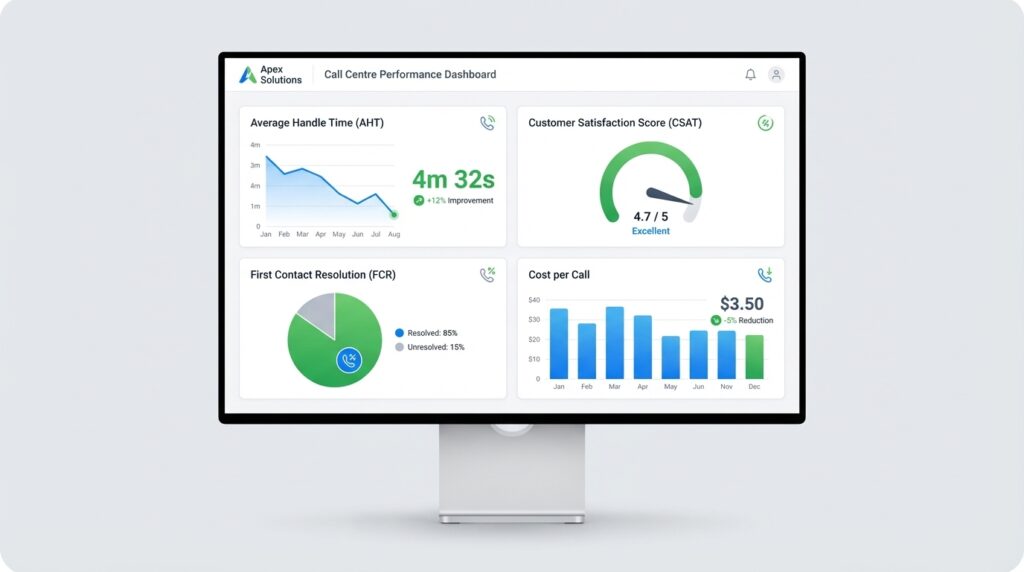
Measuring AI ROI goes beyond simple cost calculations. You need to track both quantitative performance metrics and qualitative business impacts. Here are the essential KPIs organised by category:
Efficiency Metrics
- Average Handle Time (AHT): Studies show AI can reduce AHT by up to 40%. Track the before-and-after comparison.
- First Contact Resolution (FCR): AI-powered knowledge bases and agent assistance can improve FCR by 25-35%.
- Cost per Contact: Many organisations report 30% reductions in cost per interaction after AI implementation.
- Call Volume Handled: With AI handling routine queries, measure how many more interactions your team manages without additional headcount.
Quality Metrics
- Customer Satisfaction Score (CSAT): AI-driven personalisation and faster resolutions typically boost CSAT by 15-20%.
- Net Promoter Score (NPS): Track whether customers are more likely to recommend your service after AI implementation.
- Quality Assurance Scores: AI can analyse 100% of interactions versus the typical 1-3% that human QA teams review, ensuring consistent quality.
Agent Experience Metrics
- Agent Productivity: Measure calls handled per agent per day—AI can boost this by up to 35%.
- Agent Satisfaction: Survey agents about AI tools. High adoption correlates with positive ROI.
- Training Time: AI reduces onboarding time for new agents by providing real-time guidance.
Financial ROI Calculation
Use this formula: ROI = (Gain from Investment – Cost of Investment) / Cost of Investment × 100
For example, a large telecom company implemented AI chatbots and agent assistance tools. After six months, they reported 35% reduction in AHT, 28% increase in FCR, 22% improvement in CSAT, and 40% decrease in cost per interaction. They achieved full ROI within nine months and projected long-term annual savings of ₹12 crores.
Don’t forget “soft ROI” metrics like employee sentiment, brand reputation, and competitive advantage. These may not appear directly on the balance sheet but significantly impact long-term business health.
What Are Common Implementation Challenges and Solutions?
Every AI implementation encounters obstacles. Here’s how to navigate the most common challenges:
Challenge 1: System Integration Complexity
Problem: Integrating AI with legacy CRM, telephony, and database systems can be technically complex and time-consuming.
Solution: Choose AI vendors with strong technical support and pre-built integrations. Test systems in phases to identify issues early. Consider cloud-based solutions that layer over existing infrastructure without requiring complete system replacement. Budget 20-30% more time than vendors estimate for integration work.
Challenge 2: Employee Resistance
Problem: Agents fear job loss or workflow disruption when AI is introduced.
Solution: Involve agents early in the planning process. Communicate transparently about AI’s role as a support tool, not a replacement. Share success stories from pilot programmes. Create internal AI champions who can advocate for the technology. Highlight how AI eliminates tedious tasks, allowing agents to focus on more rewarding work.
Challenge 3: Data Privacy and Security Concerns
Problem: AI systems process sensitive customer data, raising privacy and compliance concerns.
Solution: Implement encryption for data in transit and at rest. Follow privacy-by-design principles. Ensure compliance with regulations like GDPR, India’s Personal Data Protection Bill, and industry-specific requirements (HIPAA for healthcare, PCI DSS for payments). Conduct regular security audits. Be transparent with customers about how AI analyses their data.
Challenge 4: Inconsistent Results During Early Deployment
Problem: AI accuracy may be inconsistent in early stages, leading to agent frustration.
Solution: Set realistic expectations—AI improves over time through machine learning. Start with use cases where 80-85% accuracy is acceptable. Provide easy feedback mechanisms for agents to flag incorrect AI suggestions. Use these corrections to refine models continuously. Don’t expect perfection immediately; focus on steady improvement.
How Do You Ensure Ethical AI Practices?
As AI becomes more prevalent in customer interactions, ethical considerations become paramount. Here’s how to implement AI responsibly:
Transparency: Be open about how AI analyses calls and scores agent performance. Avoid “black box” systems where decisions can’t be explained. Customers should know when they’re interacting with AI versus human agents.
Bias Reduction: AI models can perpetuate biases present in training data. Regularly audit AI decisions for unfair patterns. Ensure training data represents diverse customer demographics. If your AI performs poorly for certain accents or dialects, expand your training dataset.
Human Oversight: Always maintain human decision-making authority for high-stakes interactions. AI should recommend, not dictate. Agents must be able to override AI suggestions when they disagree. For sensitive situations—angry customers, complex complaints, vulnerable populations—route to human agents.
Privacy Protection: Collect only the data necessary for AI functionality. Anonymise personal information where possible. Provide clear opt-out options for customers who don’t want AI-powered service. Store data securely and delete it when no longer needed.
What Does the Future Hold for Call Centre AI?
AI technology continues to evolve rapidly. Here are trends shaping the future of call centre AI in India and globally:
Hyper-Personalisation: Future AI will leverage customer data to deliver uniquely tailored experiences. Imagine a system that remembers a customer called during Diwali last year about a specific product and proactively offers relevant updates this year.
Emotion AI: Advanced sentiment analysis will detect not just what customers say but how they feel—frustration, confusion, satisfaction. AI will adjust responses in real-time based on emotional cues, and alert supervisors when intervention is needed.
Omnichannel Intelligence: AI will seamlessly integrate across voice, chat, email, WhatsApp, and social media, maintaining context as customers switch channels. In India, where WhatsApp is ubiquitous, this integration is particularly valuable.
Predictive Service: AI will anticipate customer needs before they contact support. For instance, if a customer’s internet service shows signs of degradation, AI could proactively send troubleshooting steps or schedule a technician visit.
Voice Biometrics: Customers will be authenticated by their unique voice patterns, eliminating tedious security questions and reducing fraud while improving the customer experience.
Real-World Success Stories from India
Let me share a few examples that illustrate effective AI implementation in Indian contexts:
Healthcare Provider in Kerala: A multi-speciality hospital implemented AI-powered call transcription and sentiment analysis for their 50-agent call centre. Within three months, they reduced call handling time by 32%, improved patient satisfaction scores from 78% to 89%, and identified common complaint patterns that led to process improvements in admissions and billing. The AI’s Malayalam transcription capability was particularly valuable for serving local patients.
Mumbai-Based Fintech Startup: Facing explosive growth, this company deployed AI chatbots for routine enquiries about account balances, transaction status, and KYC requirements. The chatbots handled 65% of incoming queries, allowing human agents to focus on complex cases like loan applications and fraud investigations. Cost per interaction dropped by 41%, and they scaled from 80,000 to 200,000 monthly interactions without increasing headcount.
National Telecom Provider: This organisation implemented AI-powered quality assurance that analyses 100% of customer calls instead of the previous 2% sample rate. They discovered systematic issues in their plan upgrade process that were causing customer confusion. After addressing these gaps, their NPS increased by 12 points, and plan upgrade success rates improved by 24%.
Practical Implementation Checklist
Here’s a step-by-step checklist for your AI implementation journey:
Pre-Implementation (Weeks 1-6)
- Define clear business objectives using SMART framework
- Audit current call centre operations and identify automation opportunities
- Assess existing technology infrastructure and integration requirements
- Evaluate and shortlist AI vendor solutions
- Clean and prepare customer data for AI training
- Establish baseline metrics for comparison (AHT, FCR, CSAT, cost per call)
- Develop change management and training plan
Pilot Phase (Months 2-4)
- Select specific use case for pilot (e.g., after-hours chatbot or call summarisation)
- Configure AI system and integrate with existing platforms
- Train small group of agents on AI tools
- Launch pilot and monitor closely
- Collect quantitative metrics and qualitative feedback
- Identify issues and refine approach
Expansion Phase (Months 5-8)
- Based on pilot results, expand to additional teams or use cases
- Deepen system integrations (CRM, knowledge base, customer data platforms)
- Roll out comprehensive agent training programme
- Establish governance framework for AI oversight
- Implement continuous monitoring dashboards
Optimisation Phase (Months 9+)
- Scale AI across entire operation
- Continuously refine AI models based on new data
- Regular performance reviews against KPIs
- Explore additional AI capabilities (new channels, advanced analytics)
- Share success metrics with leadership and stakeholders
Conclusion: Your Path to AI-Powered Customer Service
Implementing AI in your call centre isn’t about chasing the latest technology trend—it’s about fundamentally improving how you serve customers while optimising operational efficiency. The organisations seeing the greatest success are those that approach AI strategically: setting clear goals, following phased implementation, investing in quality data, training agents comprehensively, and measuring results rigorously.
The good news is that AI technology has matured significantly. The tools are more accessible, accurate, and affordable than ever before. Whether you’re running a 10-agent support desk or a 500-agent contact centre, there are AI solutions scaled to your needs and budget.
Remember that successful AI implementation is a journey, not a destination. Start small, prove value, and expand systematically. Prioritise change management as much as technology selection. Keep the focus on enhancing human capabilities rather than replacing them. And always measure results against clear business objectives.
The call centres that will thrive in 2025 and beyond are those that embrace AI as a strategic asset. The question isn’t whether to implement AI—it’s how quickly you can do so effectively whilst maintaining the quality and human touch that your customers value.
How much does it cost to implement AI in a call centre?
Implementation costs vary widely based on call centre size, chosen features, and deployment model. For small operations (10-50 agents), expect initial costs of ₹5-15 lakhs for basic AI chatbots or call analytics. Mid-sized centres (50-200 agents) typically invest ₹20-50 lakhs for comprehensive AI solutions including voice bots, sentiment analysis, and quality assurance. Enterprise deployments (200+ agents) can range from ₹75 lakhs to ₹2 crores for fully integrated AI platforms. However, most organisations achieve positive ROI within 3-6 months due to cost savings from reduced handling time and improved efficiency. Cloud-based solutions typically have lower upfront costs but ongoing subscription fees, whilst on-premise solutions require larger initial investment but lower recurring costs.
Will AI replace human call centre agents?
No, AI is designed to augment human agents, not replace them. Industry research shows that 75% of customer experience leaders believe agent roles will evolve into ‘AI managers’ who oversee automated systems whilst handling complex, high-value interactions. AI excels at repetitive tasks like password resets, order status enquiries, and basic troubleshooting. However, human agents remain essential for nuanced situations requiring empathy, creative problem-solving, and judgment. The most successful call centres use AI to handle routine queries (often 60-70% of volume), freeing agents to focus on building customer relationships and resolving complex issues. This actually makes agent roles more skilled and valuable, not obsolete.
How long does it take to implement call centre AI?
Implementation timelines vary based on scope and complexity. A basic chatbot for simple enquiries can be deployed in 4-6 weeks. Comprehensive AI implementation with call analytics, sentiment analysis, and agent assistance typically takes 3-6 months from planning to full deployment. The phased approach I recommend follows this timeline: Assessment and Planning (4-6 weeks), Pilot Programme (2-3 months), Integration and Refinement (3-4 months), then ongoing optimisation. Organisations that rush implementation often encounter integration issues and agent resistance. Taking time to properly prepare data, train staff, and test systems in controlled pilots leads to smoother rollout and faster time-to-value.
Can AI handle multiple Indian languages in call centres?
Yes, modern AI systems support multilingual capabilities essential for Indian call centres. Leading platforms now offer accurate speech recognition and natural language processing for Hindi, Tamil, Telugu, Bengali, Marathi, and other regional languages alongside English. This is particularly valuable given India’s linguistic diversity. When selecting AI vendors, specifically verify their accuracy rates for the languages your customers speak. Some systems handle code-switching (mixing languages in one conversation) better than others. For best results, choose AI trained on diverse Indian language datasets rather than systems primarily trained on Western languages and adapted later.
What metrics prove call centre AI is working?
Track both efficiency and quality metrics to demonstrate AI value. Key efficiency metrics include Average Handle Time (target: 30-40% reduction), First Contact Resolution (target: 25-35% improvement), and Cost per Contact (target: 25-30% reduction). For quality, monitor Customer Satisfaction Score (target: 15-20% improvement), Net Promoter Score, and Quality Assurance scores. Don’t overlook agent metrics like productivity (calls handled per day), agent satisfaction, and adoption rates. Calculate financial ROI using the formula: (Gain from Investment – Cost of Investment) / Cost of Investment × 100. Most successful implementations achieve positive ROI within 3-6 months, with long-term annual savings often exceeding initial investment by 200-300%.
One comment on “Call Centre AI Implementation: Best Practices Guide 2026”
[…] Call centre transcription and captioning: Aim for 2-second latency as the sweet spot. This delivers only 1% accuracy degradation compared to batch processing whilst maintaining real-time context for agent assistance and quality monitoring. […]