AI Calling Platforms 2026 – Investment Analysis & Platform Comparison
The AI calling platforms market has evolved from speculative novelty to mission-critical enterprise infrastructure. As we enter 2026, organisations face a pivotal decision: which voice AI platform delivers genuine operational value versus riding the hype cycle? This comprehensive analysis examines the technological maturity, investment viability, and platform capabilities defining the $41.39 billion conversational AI market.
With enterprises across healthcare, financial services, and customer support achieving 50-80% call deflection rates and operational cost reductions of 30-40%, the question isn’t whether to adopt voice AI, but rather which architectural approach—cloud-native orchestration, proprietary end-to-end platforms, or self-hosted middleware—aligns with your sovereignty, cost, and integration requirements.
The Market Reality: From Hype to Operational Infrastructure
The conversational AI market reached $14.29 billion in 2025, projected to expand to $41.39 billion by 2030 at a 23.7% CAGR. More significantly, the agentic AI segment—platforms capable of executing backend workflows, not merely chatting—demonstrates a staggering 46.3% CAGR, reaching $52.62 billion by 2030.
This acceleration reflects a fundamental re-platforming of customer interfaces. Traditional IVR systems are being displaced by voice AI agents that understand context, execute multi-step workflows, and operate with human-equivalent naturalness. Healthcare practices now achieve 100% call answer rates, eliminating the endemic problem of 24% missed inbound calls. Financial institutions report 94% reductions in wait times for routine enquiries.
The investment climate has matured correspondingly. Venture capital no longer backs thin “wrapper” startups layering UI over OpenAI APIs. Instead, capital flows to vertical AI solutions with proprietary data moats and infrastructure plays offering deployment sovereignty. The “AI Supernova” archetype—reaching $40 million ARR within year one whilst operating at $1.13 million revenue per employee—demonstrates unit economics 4-5x superior to traditional SaaS.
The Latency Breakthrough: Why Sub-Second Response Defines Success
The technical pivot enabling this market maturation is the shift from cascade architecture to end-to-end speech processing. Legacy systems requiring sequential Speech-to-Text → LLM → Text-to-Speech handoffs introduced cumulative latency exceeding 3-5 seconds. Human conversation perceives gaps beyond 500-700ms as awkward, triggering the “barge-in” problem where callers assume system failure and restart their utterance.
Leading platforms now achieve sub-second latency through unified speech-to-speech models processing raw audio tokens directly:
- Retell AI: Consistently below 800ms with proprietary turn-taking models
- Vapi: Sub-600ms in optimised configurations
- OpenAI Realtime API: Native audio-to-audio processing eliminating transcription overhead
- VEXYL Gateway Mode: Sub-200ms for direct streaming to providers like OpenAI Realtime
- Speechmatics: Partial transcripts in 250ms, end-of-speech detection in 400ms
This latency threshold isn’t merely technical—it determines conversion rates, customer satisfaction scores, and operational viability for high-stakes interactions. Research consistently demonstrates that delays exceeding one second create rapid degradation in both sales conversions and CSAT metrics.
Platform Comparison: Cloud Orchestration vs Self-Hosted Middleware
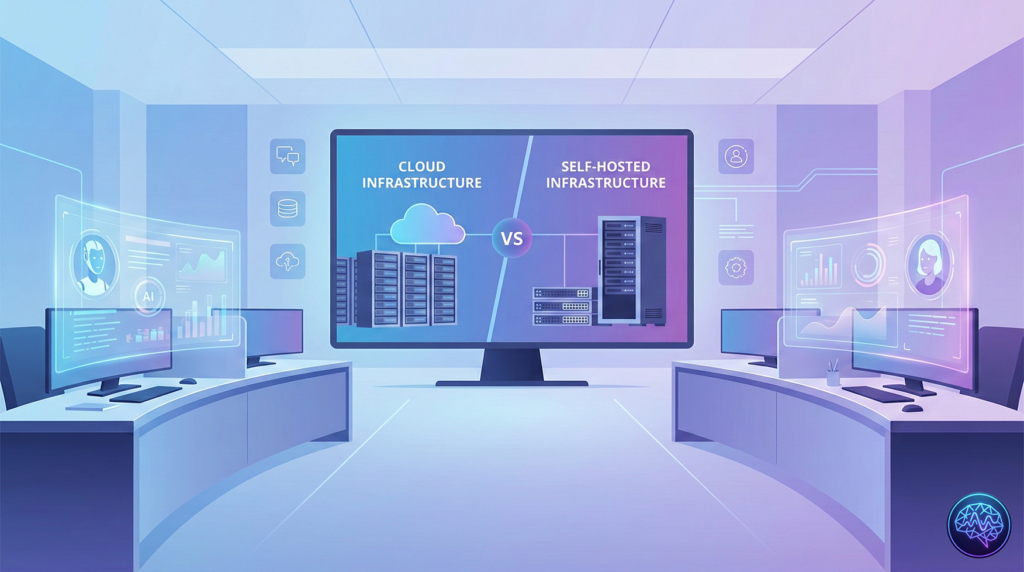
The 2026 AI calling platforms landscape divides into three distinct architectural philosophies: cloud-native orchestrators prioritising flexibility, proprietary end-to-end platforms controlling the entire stack, and self-hosted middleware enabling data sovereignty. Each approach presents distinct trade-offs in cost predictability, vendor lock-in, and compliance posture.
| Feature | Retell AI | Bland AI | Vapi | VEXYL | OpenAI Realtime |
|---|---|---|---|---|---|
| Architecture | Cloud-native telephony wrapper | Proprietary end-to-end platform | Multi-vendor orchestration layer | Self-hosted middleware for Asterisk/FreePBX | Native multimodal API |
| Deployment | SaaS only | SaaS only | SaaS only | On-premises / Private VPC | API (cloud-based) |
| Latency | <800ms | ~1-2s (variable) | 600-900ms | <200ms (Gateway), 2.2-3.3s (Standard) | Ultra-low native |
| Pricing Model | $0.07/min flat rate | $0.09/min + attempt fees | $0.05/min + vendor costs | Per-seat licensing (~$10-15/seat/month) | Token-based (unpredictable) |
| Key Differentiator | Verified numbers, developer-friendly | Conversational Pathways, proprietary TTS | Zero vendor lock-in, swap any component | 87-91% cost savings, data sovereignty, Indian languages | Best-in-class naturalness |
| Telephony Integration | Built-in SIP trunking | Built-in with outbound focus | Bring your own carrier | AudioSocket protocol (Asterisk native) | Requires middleware |
| AI Provider Flexibility | Limited to platform choices | Proprietary models only | 17+ providers (OpenAI, Anthropic, Groq, etc.) | 17+ providers including Sarvam AI, regional models | OpenAI only |
| Language Support | Multilingual via providers | Multilingual via providers | 100+ languages | 10+ Indian languages (Malayalam native), 100+ via providers | Multilingual |
| Compliance | SOC2, HIPAA, GDPR | SOC2, HIPAA | Depends on vendors | Full data sovereignty, custom compliance | Enterprise tier available |
| Best For | Developer teams wanting reliability | Enterprises needing turnkey solution | Teams avoiding vendor lock-in | Healthcare/government requiring data sovereignty, cost-conscious enterprises with existing PBX | Developers building custom infrastructure |
| Production Evidence | EV support, medical dispatch | High-volume outbound campaigns | Custom voice products at scale | Healthcare deployments: 1,000+ monthly interactions, 95% satisfaction | Powering multiple platforms |
Understanding the Self-Hosted Advantage: VEXYL’s Positioning
Whilst cloud platforms like Retell and Vapi offer rapid deployment, they introduce per-minute costs that become prohibitive at enterprise scale. A contact centre handling 30,000 minutes monthly faces $2,100-2,700 in cloud platform fees alone, before accounting for underlying AI provider costs. Over 36 months, this totals $75,600-97,200 in operational expenditure.
VEXYL AI Voice Gateway represents a fundamentally different economic model. As self-hosted middleware sitting between existing Asterisk/FreePBX infrastructure and AI providers, it eliminates per-minute platform fees entirely. Organisations pay predictable per-seat licensing (approximately $10-15 per concurrent seat monthly), achieving 87-91% cost savings versus cloud alternatives.
This architectural approach addresses three enterprise imperatives simultaneously:
- Data Sovereignty: Healthcare and government sectors requiring on-premises processing for PHI/PII compliance cannot utilise cloud platforms. VEXYL processes audio locally, sending only necessary data to AI providers under organisational control.
- Legacy Integration: Enterprises with existing Asterisk/FreePBX investments (representing millions in sunk infrastructure costs) cannot justify complete replacement. VEXYL’s AudioSocket protocol integration preserves these investments whilst enabling AI capabilities.
- Cost Predictability: Per-seat licensing converts variable operational expenditure into fixed costs, crucial for budget planning and financial modelling in CFO-led procurement processes.
The platform operates in dual modes: Gateway Mode streams audio directly to providers like OpenAI Realtime API with sub-200ms latency, whilst Standard Mode uses the traditional STT→LLM→TTS pipeline with aggressive caching (90% TTS hit rates) for structured applications requiring custom data integration.
Regional Language Support: The Indian Market Differentiator
Whilst global platforms offer multilingual capabilities through their AI providers, VEXYL’s native support for 10+ Indian languages—particularly Hindi,Tamil—creates substantial competitive advantages in regional markets. Production healthcare deployments demonstrate this value: processing over 1,000 monthly patient interactions in regional Indian languages with 95% satisfaction rates.
This capability addresses a critical gap. Global AI providers’ Indian language models often struggle with dialectical variations, code-switching between English and regional languages, and domain-specific terminology. VEXYL’s integration with providers like Sarvam AI (specialising in Indian linguistics) and ability to deploy custom fine-tuned models locally solves this challenge.
For organisations serving Indian markets—whether government services processing Malayalam, Karnataka’s Kannada-speaking populations, or Pan-India operations requiring Hindi with regional variations—this native language handling isn’t a feature but a fundamental enabler. The alternative of forcing English-only interactions creates accessibility barriers and reduces adoption rates amongst non-English-comfortable demographics.
Build vs Buy: The Architecture Decision Framework
Selecting an AI calling platform requires mapping your organisation’s priorities across five dimensions:
1. Deployment Sovereignty Requirements
Choose Cloud Platforms (Retell, Bland, Vapi) if you prioritise rapid deployment, don’t handle regulated data requiring on-premises processing, and accept vendor dependency for infrastructure reliability.
Choose Self-Hosted (VEXYL, Jambonz) if you operate in healthcare/government sectors with strict data sovereignty mandates, process PHI/PII requiring local control, or serve markets (EU, China, India) with data localisation regulations.
2. Cost Structure Preference
Variable Pricing (cloud platforms) suits organisations with unpredictable call volumes, seasonal fluctuations, or early-stage experimentation where fixed infrastructure costs create risk.
Fixed Licensing (self-hosted) becomes economically superior at scale. The breakeven point typically occurs between 10,000-15,000 minutes monthly, beyond which per-minute cloud costs exceed self-hosted infrastructure and licensing combined.
3. Technical Capability In-House
Cloud platforms abstract infrastructure complexity but constrain customisation. Self-hosted solutions demand DevOps capability (Docker orchestration, network configuration, monitoring) but enable unlimited customisation and integration depth.
VEXYL addresses this through Docker distribution and comprehensive documentation, reducing the technical barrier whilst preserving deployment control. Organisations with existing Asterisk expertise find the learning curve minimal.
4. AI Provider Strategy
Single-Provider Commitment: OpenAI Realtime API offers the most natural voices and reasoning but locks you into their ecosystem and pricing.
Multi-Provider Flexibility: Vapi and VEXYL allow mixing providers (e.g., Deepgram for STT, Claude for reasoning, ElevenLabs for TTS) to optimise cost and quality per component.
Proprietary Stack: Bland AI’s custom models avoid dependency on frontier model providers but sacrifice the continuous improvement cycles that OpenAI/Anthropic investment enables.
5. Integration Complexity
For greenfield implementations without legacy telephony, cloud platforms offer fastest time-to-value. For organisations with existing Asterisk/FreePBX infrastructure, middleware like VEXYL preserves investments whilst adding AI capabilities through AudioSocket integration requiring minimal PBX configuration changes.
Real-World ROI: Healthcare and Enterprise Case Studies
Abstract capabilities matter less than measurable operational impact. The following evidence demonstrates where voice AI agents deliver genuine value versus perpetuating hype:
Healthcare: The Killer Application
Healthcare practices face structural inefficiency: 24% of inbound calls go unanswered due to administrative overload. Production AI voice deployments demonstrate quantifiable resolution: 100% call answer rates, reducing administrative burden by 15-20 hours weekly per staff member, and improving patient satisfaction scores by 20-35%.
The economic case is compelling. A practice with three reception staff spending 60% of time on phone tasks recovers 36 hours weekly through AI automation. At $32/hour fully loaded cost, this represents $59,904 annual savings. With VEXYL’s per-seat licensing at approximately $180-360 annually (versus cloud platforms’ $25,200-32,400 for equivalent volume), the ROI exceeds 16,000%.
Critically, medical-specific voice models trained on clinical terminology achieve 70% lower error rates than generic models, making them safe for clinical documentation and patient communication. Speechmatics reports 15x growth in medical model usage during 2025, validating the vertical specialisation thesis.
Financial Services: Compliance-Native Automation
A multinational bank deployed AI support achieving 94% wait time reduction for common enquiries and 37% decrease in escalations to specialised teams. The success factors included sophisticated sentiment analysis routing angry customers immediately to human supervisors, and maintaining complete audit trails for regulatory compliance.
For organisations in regulated industries, platform selection hinges on compliance architecture. Self-hosted solutions like VEXYL enable custom compliance controls—PII redaction, conversation encryption, audit log retention—impossible with opaque cloud platforms where data processing occurs in vendor-controlled infrastructure.
High-Volume Contact Centres: Deflection Economics
Mature deployments now achieve 50-80% deflection rates for Level 0/1 support (password resets, order status, appointment scheduling). Freshworks reports AI agents deflect over 45% of incoming queries for their clients, reducing operational costs by 30-40% whilst slashing resolution times from hours-in-queue to minutes.
The deflection metric, however, obscures a more important question: resolution quality. A 70% deflection rate creating frustrated customers who eventually reach humans anyway merely delays rather than solves problems. Best-in-class implementations focus on containment—truly resolving the issue without human intervention—requiring backend integration capabilities for write-actions (processing refunds, scheduling appointments, updating records).
Regulatory Moats: TCPA, AI Act, and Compliance-Native Architecture
The 2025-2026 regulatory environment fundamentally altered voice AI economics, particularly for outbound applications. Understanding these constraints prevents costly deployment failures and legal exposure.
US TCPA: The Death of Cold Calling
The FCC’s 2024 declaratory ruling classifying AI-generated voices as “artificial or prerecorded voices” under TCPA mandates Prior Express Written Consent for AI calls to mobile phones. Crucially, consent cannot be bundled into general terms—it requires separate, explicit opt-in specifically for AI calling.
Penalties range from $500-1,500 per call. A 10,000-call campaign risks millions in liability. The AI Biden robocall case resulted in a proposed $6 million fine, signalling aggressive enforcement. This effectively kills the business model of purchasing lead lists for AI outbound campaigns.
Platforms building compliance-native features—automatic consent logging, call recording with timestamp validation, PII redaction—will dominate enterprise procurement. Both Retell and Bland offer these capabilities, but self-hosted solutions like VEXYL enable custom compliance workflows matching specific regulatory interpretations.
EU AI Act: Transparency and High-Risk Classification
Full AI Act transparency rules commence August 2026. Deployers must disclose AI interaction to natural persons—the “Turing test” deception is now illegal. Synthetic audio requires machine-readable watermarking for deepfake detection.
Emotion recognition—a key 2026 trend for customer service—falls under “high-risk” classification requiring rigorous risk assessments and data governance. Platforms claiming sentiment analysis capabilities without GDPR-compliant data processing expose organisations to regulatory action.
Self-hosted deployments simplify compliance by keeping data processing within organisational boundaries. When audio never leaves your infrastructure (VEXYL’s on-premises processing), GDPR’s cross-border transfer restrictions become moot.
2026 Investment Thesis: Vertical Integration and Infrastructure Plays
The era of funding generic “AI receptionists” has concluded. Investment value has migrated to two categories:
Vertical AI with Proprietary Data Moats
Platforms solving specific high-value problems—healthcare prior authorisation, legal discovery, industrial maintenance—with domain-specific training data create defensible positions. The “moat” isn’t the LLM (commoditising rapidly) but the clean, structured proprietary data preventing hallucinations.
ServiceNow’s AI products reaching $1 billion contract value by 2026 validates enterprise appetite for verticalized agents. Expect M&A consolidation where incumbent SaaS giants (Salesforce, HubSpot) acquire AI-native startups for workflow integration rather than building from scratch.
Infrastructure Enabling Deployment Sovereignty
As organisations recognise vendor lock-in risks and cost explosions from per-minute cloud pricing, demand grows for self-hosted infrastructure enabling AI capability without cloud dependency. Platforms like VEXYL, Jambonz, and LiveKit address this through deployment-agnostic architecture.
The investment opportunity lies in enabling enterprise AI adoption at economic scales sustainable for CFO approval. Cloud platforms work for experimentation; infrastructure plays win long-term enterprise contracts where predictable costs and data sovereignty trump rapid iteration.
Failure Modes: The Hype Reality Check
Balanced analysis demands examining where these systems fail. The “hype” suggests flawless AI; production reality reveals seven recurring failure patterns:
- Hallucination Cascades: One early error (inventing a nonexistent product SKU) propagates through the entire workflow, compounding into disaster as shipping, billing, and confirmations build on false information.
- Context Corruption: Poisoned memory entries where false information persists across sessions. An incorrect “VIP” or “Fraud Risk” tag permanently breaks the customer relationship.
- Looping Chaos: “I didn’t quite catch that” loops represent the primary cause of user churn and frustration, occurring when VAD (Voice Activity Detection) fails to recognise speech endpoints.
- Latency-Induced Barge-In: Two-second response delays cause humans to restart utterances, creating “talking over each other” chaos as the AI processes old audio whilst ignoring new interruptions.
- Tool Misuse: Agents executing API calls with incorrect parameters—deleting database records instead of archiving them—due to ambiguous prompts or inadequate safeguards.
- Uncanny Valley Trust Erosion: Voice quality reaching “almost human but slightly off” creates more distrust than obviously synthetic voices. 53% of consumers actively dislike AI in service interactions.
- Resolution Facade: High deflection rates masking low containment—the bot “handles” the call but fails to solve the problem, forcing eventual human escalation after wasting customer time.
Hybrid models performing triage with seamless escalation to humans with full context outperform purely automated systems because they respect users’ desire for human connection in complex or emotional scenarios. The goal isn’t replacing humans but optimising when human judgment matters.
Selection Criteria: The 2026 Enterprise Buyer’s Checklist
Based on production deployments and investment analysis, evaluate AI calling platforms across these dimensions:
- Latency Control: Can the platform consistently deliver sub-second responses? Who owns the latency stack—you or third-party APIs introducing unpredictable delays?
- Compliance Architecture: Is TCPA/GDPR/HIPAA compliance baked into the platform, or an afterthought requiring custom development? Can you implement region-specific requirements?
- Cost Predictability: At your projected call volume, does per-minute pricing remain sustainable, or does self-hosted licensing offer superior economics?
- Data Sovereignty: For regulated industries, can you process audio locally without external transmission? Do you control retention and deletion policies?
- Integration Depth: Can the agent execute write-actions (schedule appointments, process refunds), or merely read information? Does it integrate with your existing CRM/ERP/EHR?
- Memory and Context: Does the agent recall past interactions across channels, or suffer “amnesia” forcing customers to repeat information?
- Vertical Specialisation: For industry-specific applications (medical, legal, financial), are domain-tuned models available with lower error rates?
- Vendor Lock-In: Can you swap AI providers (STT, LLM, TTS) if better options emerge, or are you locked into the platform’s choices?
- Production Evidence: Does the vendor demonstrate measurable results in comparable deployments, or merely impressive demos?
Frequently Asked Questions
What is the difference between cloud-based and self-hosted AI calling platforms?
Cloud-based platforms like Retell AI and Vapi operate as SaaS services where you pay per-minute usage fees and the vendor manages infrastructure. Self-hosted solutions like VEXYL deploy on your infrastructure, offering data sovereignty and fixed per-seat costs. Cloud platforms provide faster setup but create vendor dependency and variable costs. Self-hosted requires DevOps capability but delivers 87-91% cost savings at scale whilst keeping sensitive data on-premises—critical for healthcare and government sectors with regulatory requirements.
How much does AI voice automation actually cost for enterprise deployments?
Cloud platforms typically charge $0.05-0.09 per minute plus underlying AI provider costs. A contact centre handling 30,000 minutes monthly faces $2,100-2,700 in platform fees alone, totalling $75,600-97,200 over three years. Self-hosted solutions like VEXYL use per-seat licensing at approximately $10-15 per concurrent seat monthly, converting to $360-540 annually per seat. The breakeven point occurs around 10,000-15,000 minutes monthly, beyond which self-hosted becomes economically superior. Factor in data sovereignty benefits for regulated industries.
Which AI calling platform is best for healthcare organisations?
Healthcare requires three capabilities: sub-second latency for natural conversation, HIPAA-compliant data handling with full audit trails, and medical-terminology accuracy. VEXYL excels for organisations with existing Asterisk/FreePBX infrastructure, offering on-premises processing for PHI protection and 70% lower error rates with medical-specific models. Production healthcare deployments demonstrate viability with 1,000+ monthly patient interactions achieving 95% satisfaction. Cloud platforms like Retell work for practices accepting SaaS compliance frameworks and willing to accept per-minute costs.
Can AI voice agents handle Indian languages effectively?
Generic AI providers offer basic Hindi support but struggle with dialectical variations, code-switching, and regional languages. VEXYL provides native support for 10+ Indian languages including Malayalam, Kannada, Tamil, and Hindi variants through integration with providers like Sarvam AI specialising in Indian linguistics. The platform’s self-hosted architecture enables deployment of custom fine-tuned models for specific regional requirements. For organisations serving Indian markets, this native language handling isn’t optional—it’s fundamental to accessibility and adoption amongst non-English-comfortable demographics.
What are the main regulatory risks with AI calling platforms in 2026?
The FCC’s TCPA ruling mandates Prior Express Written Consent for AI calls to mobile phones, with penalties of $500-1,500 per call. Cold-calling business models face existential risk. The EU AI Act requires disclosure of AI interaction (no Turing test deception) and emotion recognition falls under high-risk classification requiring rigorous compliance. Self-hosted platforms like VEXYL simplify compliance by keeping data processing on-premises, avoiding GDPR cross-border transfer complexity. Choose platforms with compliance-native features: consent logging, call recording validation, PII redaction, and audit trails.
Conclusion: Strategic Platform Selection for 2026
The AI calling platforms market has definitively transitioned from speculative hype to operational infrastructure. Platforms can solve real issues—achieving 50-80% call deflection, 94% wait time reduction, and 30-40% operational cost savings—but only when architectural choices align with organisational requirements.
Cloud platforms excel for rapid experimentation and greenfield deployments where speed trumps cost optimisation. Self-hosted middleware like VEXYL dominates when data sovereignty, cost predictability, and legacy integration matter—particularly for healthcare, government, and enterprises with existing PBX infrastructure.
The winners in 2026 aren’t platforms with the longest feature lists but those matching deployment models to enterprise realities. For organisations in regulated industries processing sensitive data, serving Indian language markets, or operating at scales where per-minute costs become prohibitive, self-hosted architecture isn’t optional—it’s strategic.
Evaluate platforms not on capability claims but production evidence: measurable results in comparable deployments, compliance architecture enabling regulatory adherence, and economic models sustainable through CFO scrutiny. The opportunity in voice AI is genuine; the challenge is separating platforms delivering structural value from those riding the hype cycle.
This analysis draws from market research covering conversational AI market projections, production deployments across healthcare and enterprise sectors, and technical evaluations of leading platforms. Cost calculations reflect January 2026 pricing and assume standard enterprise usage patterns.